Initial situation and objectives
City centers—such as Mainz's old town—serve as a reflection of economic, cultural, and social life. As the capital of Rhineland-Palatinate, Mainz's city center is not only a benchmark for the city as a whole, but also has an impact beyond the region. Numerous institutions and offerings related to social life in the city of Mainz and the state are concentrated here. Because the city center brings together a wide variety of interests from business, culture, and urban society, it is subject to constant pressure to change. As part of the adaptation of Mainz's city center to economic, social, and societal changes, it is important to mediate and balance the different perspectives. Maintaining and promoting the city's image is of great importance here, as it shapes both the internal perception and the external view of the state capital Mainz.
Contrary to the demographic trend in many other cities in Germany, the city of Mainz has recently seen its actual population growth far exceed forecasts. The city center occupies a special position in this context. Population growth here has been considerably higher than the city average. However, the increased demand for housing resulting from the population growth cannot currently be met across the board. This presents the city of Mainz with the question of how and where new housing can be generated. In addition, various private and public investment intentions and needs are currently apparent in Mainz city center. For example, plans to establish a new shopping district are currently under public discussion. Furthermore, there are various locations in Mainz city center whose future use has yet to be clarified. With all the existing ideas, projects, and potential, however, it is important to build on the strengths of the city of Mainz and jointly develop a sustainable perspective for the urban design of the city center. In this context, a broad consensus must be reached on future potential in the area of tension between preserving historical heritage and setting new architectural accents. Only if the objectives are supported by many can the perspective become a lasting and sustainable basis for the development of Mainz city center.
In order to sustainably support the general trend and the new appreciation of the city center, as well as to identify new potential for the functional strengthening of Mainz's city center, an Integrated Development Concept (IEK) is to be developed for the state capital of Mainz as a basis for future action, establishing a framework for the structural development and urban design of the city center for the next 10-15 years. The aim is to develop a comprehensive perspective for the development of Mainz city center, taking into account existing comprehensive plans, concepts, and expert reports, and integrating the relevant departments of urban planning. The aim is to establish a broad-based action program for dealing with functional, urban development, transport, and open space planning developments, which will describe a corridor for future urban and spatial development and serve as a basis for discussion and decision-making for the public, city center stakeholders, and political bodies.
The study area: The area under consideration
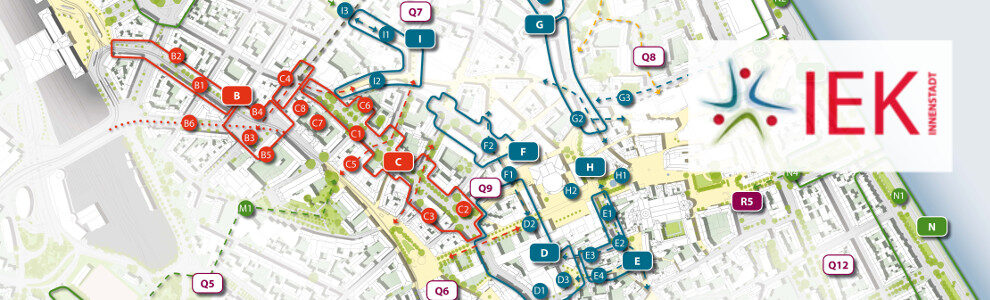
The area under consideration in the development of the integrated development concept largely encompasses Mainz's old town (the area is marked by a purple line on the map). The physical boundaries are formed by the Rhine and the green space system along the historic fortifications with the tree-lined avenues along Kaiserstraße. Against the backdrop of developments currently under discussion, a particular focus in the development of the integrated development concept should be placed on the inner city shopping area – the focus area (the area is outlined in red on the map). Due to the high level of interaction between the inner city and other urban areas, the adjacent spatial areas, particularly in the new and upper city and across the Rhine, must also be taken into account. In this context, strong attention will be paid to strengthening the entrances to the city center in the area between the main train station and the shopping district.