
Questions/Answers
What exactly is sewage sludge?

Sewage sludge is produced during the wastewater treatment process in sewage treatment plants. To this end, the wastewater (central sewage treatment plant of the city of Mainz, approx. 390,000 PE) is first cleaned mechanically, e.g., by raking systems, sand traps, and settling tanks, to remove coarse materials, and then forwarded to so-called aeration tanks for subsequent biological treatment. Microorganisms contained in the activated sludge break down the dissolved organic pollutants and nutrients in the wastewater. In the primary and secondary settling tanks, settleable solids and activated sludge are separated from the treated wastewater. This settled sludge is then digested in digestion towers for approx. 20 days, i.e., it is treated under oxygen-free conditions. It is then dewatered to approx. 28% DS (dry substance content) using centrifuges and can also be dried to 75% DS through further treatment.
Where to put the sewage sludge?
The disposal options for sewage sludge have become increasingly uncertain in recent years. Landfilling has not been permitted since 2005, and agricultural sewage sludge recycling is also no longer permitted in all federal states due to concerns about pollutants entering the soil and plants and thus the food chain.
Disposal prices also vary considerably depending on the region and disposal method (e.g., co-incineration in coal-fired power plants and cement works, as well as agricultural utilization).
This raises the question for many municipalities of how to proceed. Which disposal method is secure in the long term, environmentally friendly (soil, water, air, transport), inexpensive, and independent of third parties?
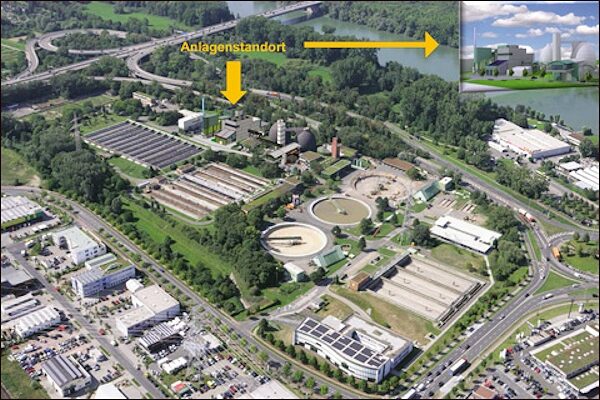
The planned thermal recycling of sewage sludge at the Mainz central sewage treatment plant (see aerial photo with location marked) will make the plant independent of electricity and natural gas supplies and the annually increasing, market-dependent disposal prices. By adding external sludge from partners (e.g., Stadtentwässerung Kaiserslautern AöR, Abwasserzweckverband "Untere Selz"), the plant's own electricity generation will be further increased in order to cover the entire energy consumption of the sewage treatment plant in Mainz independently and even CO2-neutrally.
What makes sewage sludge so interesting?
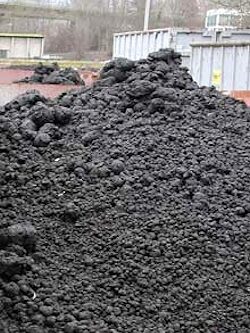
Sewage sludge is rich in nutrients, especially phosphate, which can be used as a natural fertilizer in agriculture and as a raw material for industry. Phosphate is normally extracted in open-cast mines, which is a costly process, and is often contaminated with other problematic substances such as uranium. Recycling sewage sludge would therefore be a purely natural and environmentally friendly solution.
How does a sewage sludge incineration plant work?
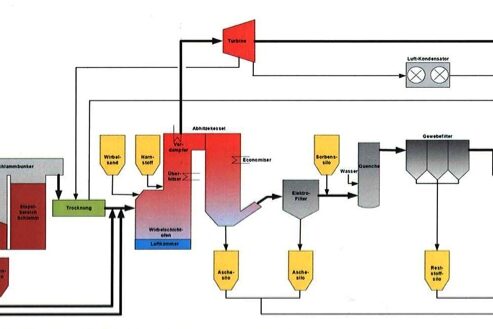
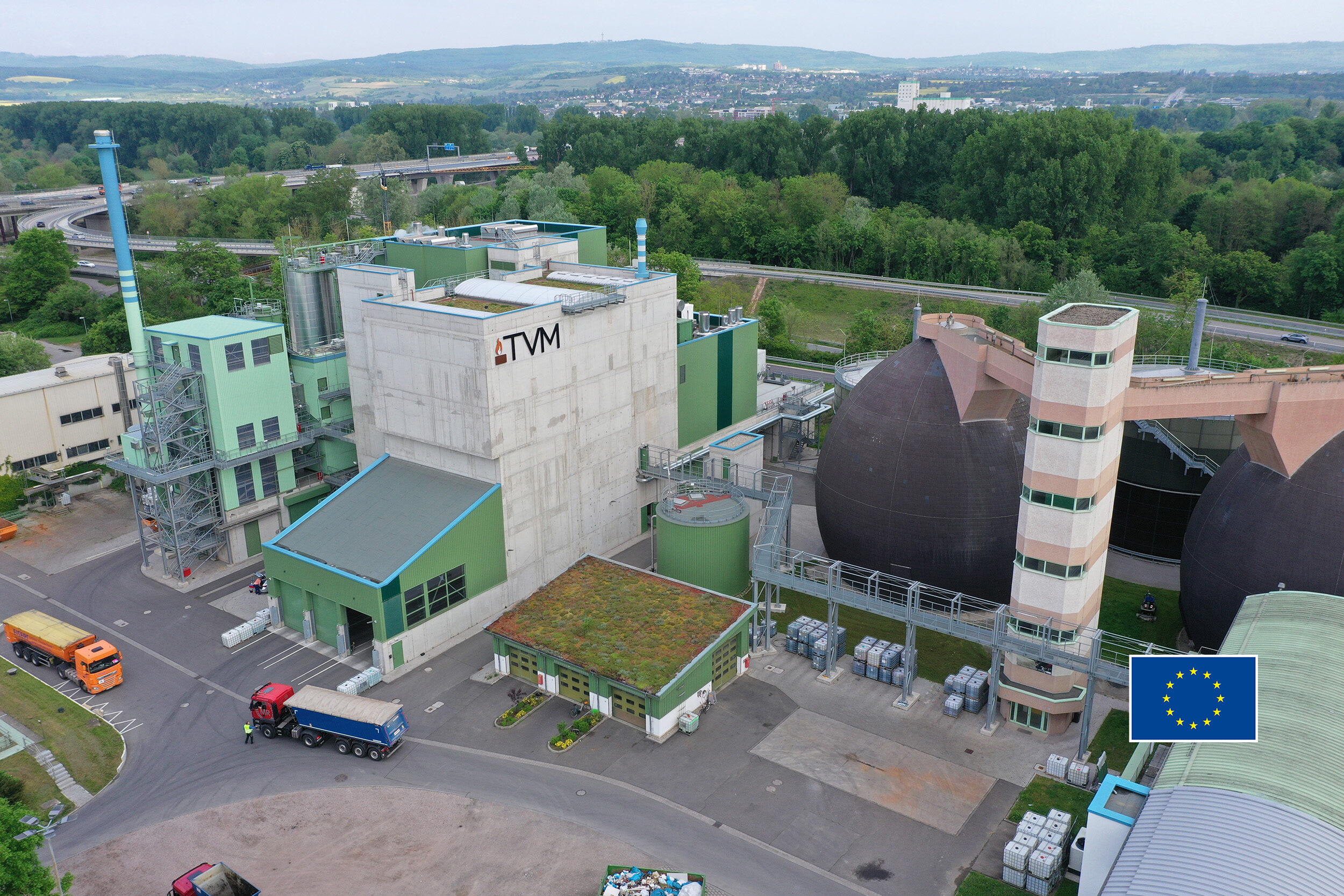
The disposal of sewage sludge through thermal recycling is carried out in a variety of ways throughout Germany. In the case of TVM, a mono-incineration plant with a fluidized bed furnace, specially built for this purpose, is planned. Mono-incineration has the advantage for sewage treatment plant operators that wastewater treatment and sewage sludge disposal take place independently at a single location and, at the same time, the "waste product" of thermal recycling (heat and electricity) can be used as surplus energy in the sewage treatment plant's operating process.
Sewage sludge incineration plants are operated at temperatures between 850 and 950 °C. The temperature level achieved during independent incineration depends on the energy content and quantity of the dried sewage sludge fed into the plant, as well as on the amount of combustion air.
What happens to the energy generated during combustion?
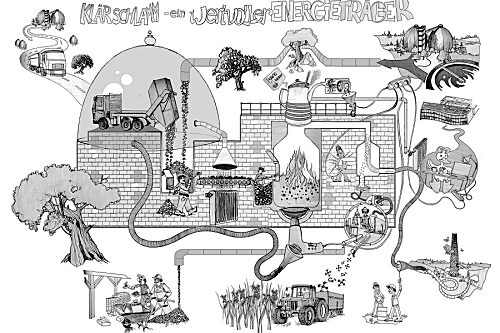
The electricity and heat generated in this way would be used to supply the Mainz central sewage treatment plant with energy. This is another important point in favor of an incineration plant. It would ultimately enable the sewage treatment plant to become "self-sufficient," which would also ensure fee stability. And to avoid additional costs and taxes (e.g., grid fees), it makes sense to set up the plant directly where the energy can be delivered immediately. This ensures long-term planning security and price stability for the sewage treatment plant operation and thus also for the fee payer.
What about environmental influences?
An intensive environmental impact assessment was carried out for the permit application, which examined the issues of noise, odor, and safety, with the result that, based on the applicable legal framework, no harmful environmental impacts, significant disadvantages, or nuisances for the general public and the neighborhood or for the protected assets under consideration are to be expected during the construction phase, during normal operation, or as a result of disruptions to normal operation.
Even the impact on nature and the landscape on the site of the central sewage treatment plant associated with the project was determined as part of an impact-compensation balance. The remaining compensation deficit, taking into account the possible compensation through measures, will be offset outside the impact area by compensation measures and tree planting. You
can read more about this in the brief descriptionPDF-File1,27 MB.
