Mainz company history in securities - an online exhibition
Mainz company history told with historical securities. An online exhibition on regional economic history
With the online exhibition "Mainz Company History in Securities," the Mainz City Archives aims to present regional economic history. It shows that strong entrepreneurial forces were already at work in the city in the 19th century. At the same time, it becomes clear that upheavals took place at that time that were no less significant in their dimensions than the changes we are facing today.
Prof. Dr. Volker Beeck and Frank Kinback, the organizers of the exhibition, have been collecting securities related to Mainz for decades. The items on display come from their collections. The organizers provide explanatory texts describing the history and significance of the companies and institutions for the city of Mainz.
Click on the company names to open.
Bausparkasse Mainz Aktiengesellschaft (BKM)

The share:
Bearer share with the number 00131 and a par value of 1,000 Reichsmark. Format: 31.0 cm x 22.9 cm. The issue, which was made around 1932, comprised 150 shares with a par value of 1,000 Reichsmark each, amounting to a total of 150,000 Reichsmark. A sheet with profit share certificate no. 20 and renewal certificate complements the share. Stamp: "The company name as of August 9, 1934, is: Bausparkasse Mainz, Aktiengesellschaft" and "Nominal value adjusted to RM 1100.00."
Bausparkasse Mainz: A house for everyone
BKM was founded on September 15, 1930, in Mainz as "Bau- und Wirtschafts Aktiengesellschaft Bausparkasse Mainz" (Mainz Building Society). The basic idea was to combine its own housing program with financing. In 1934, the company was renamed "Bausparkasse Mainz Aktien-Gesellschaft." By 1938, the company had financed 3,000 houses with around RM 29 million and doubled the financing amount by 1940.
Economic expansion in the post-war period
In the 1960s, the company began advising its customers on home ownership and retirement planning. Later, in addition to building society loans, it also offered mortgage financing and its own home program. In 1982, BKM founded its wholly owned subsidiary Mainzer Haus Vertriebs GmbH, which today operates as BKM ImmobilienService GmbH in the real estate brokerage sector. In 1966, the 100,000th building society account was opened, and six years later, the 200,000th building society account was opened. Through a partnership with the Inter Insurance Group, BKM's sales representatives have also been brokering insurance and pension products since 1993.
The BKM today
Until early 2011, BKM was one of Germany's largest privately held, publicly traded building society stock corporations. As part of a squeeze-out, minority shareholders were forced out of the company by the INTER Insurance Group.
BKM's revenue in 2024 amounted to EUR 42.4 million. The number of full-time equivalent employees as of December 31, 2024, was 187.
Casino in the Frankfurter Hof

The share
Share certificate numbered 0414, issued on April 1, 1889, with a par value of 100 marks. Format: 24.8 cm x 35.4 cm. Decorative letterhead with original signatures and framed by a garland of flowers and fruit. Re-stamped in 1925 to one hundred Reichsmarks. A sheet with ten profit share certificates nos. 11 to 20 for the years 1929 to 1938, together with a renewal certificate, supplements the document. On the inside is a stamp indicating that the liquidation proceeds (partial amount) of this share certificate in the amount of DM 864.50 were paid to the holder on September 21, 1972. The paper was therefore still valid during the DM era.
Casino in the Frankfurter Hof: Initially an inn for the Mainz carnival revellers
The Zum Frankfurter Hof inn at Augustinerstraße 55 in the heart of Mainz's old town was acquired by Konrad Falck in 1834. He added a hall to meet the ever-increasing demand for meeting places for the Mainz Carnival. The Frankfurter Hof became a political meeting place and a gathering point for the committed bourgeoisie. In 1864, Johann Falck and Andreas Schmidt purchased the building for the Catholic Reading Association, founded in 1863, which renamed itself the "Casino Society in the Frankfurter Hof" in June 1864. From 1865 onwards, the hall was made available to the "Mainzer Carneval Verein" (Mainz Carnival Association) for its campaign events. In 1938, the Frankfurter Hof served, among other things, as a reception center for Jewish refugees from the villages of Rheinhessen.
Transformation into a cultural center
In 1989, the foundation stone was laid for the renovation of the Frankfurter Hof; the reopening took place on March 10, 1991. The current owner of this historic landmark in Mainz is Kulturzentren Mainz GmbH (KMG); the modernization of the foyer was completed in late summer 2025. Whether jazz, classical music, comedy, cabaret, or children's programs—the Frankfurter Hof remains a home for diversity and quality in Mainz's cultural scene.
Chemische Werke vorm. H. & E. Albert in Amöneburg near Biebrich on the Rhine

The share:
Bearer share with the number 05152 and a par value of 1,000 marks from the issue dated July 23, 1895. Format: 35 cm x 25 cm. 10,000 shares were issued. Stamps refer to the exercise of subscription rights and the reduction of the share to 300 Reichsmarks.
Chemische Werke Biebrich: It all started with fertilizer made from slaughterhouse waste
In 1858, pharmacist and chemist Johann Heinrich Albert (1835 to 1908) and his brother Eugen Albert (1830 to 1879) founded a factory near Biebrich for the production of fertilizer from slaughterhouse waste. By 1861, the expanding business had already relocated to Amöneburg in the Grand Duchy of Hesse. The company gained international renown through its developments in fertilizers. With the double superphosphate produced since 1871, farmers were offered a fertilizer containing phosphate and calcium. Furthermore, in 1884, a special grinding process made it possible to process Thomas slag from steel production into phosphate fertilizer. In
1895, the partnership was incorporated into the stock corporation "Chemische Werke vorm. H. & E. Albert."
Conversion of production to pharmaceuticals
As a result of World War I, the company's plants in neighboring European countries were expropriated. With the fertilizer and chemical business in decline, the company switched its production to pharmaceuticals in 1922. From 1938 onwards, the company operated under the name "Chemische Werke Albert."
Hoechst takes over
After World War II, the largely destroyed plant in Amöneburg was rebuilt. Hoechst AG acquired a majority stake in 1964 and incorporated Chemische Werke Albert AG into the group in 1972. Following the merger with the neighboring Kalle plant in 1989, the company is now part of the Wiesbaden Industrial Park (Kalle-Albert).
Chr. Adt. Kupferberg & Co. Partnership limited by shares

The share:
Registered share with the number 2475 and a par value of 300 Reichsmark from the issue dated January 2, 1937. Format: 29.7 cm x 21.2 cm. Registered shares are issued in the name of the holder. They are transferred in writing (endorsement). Corresponding notes are affixed to the back of the share. Below this is a transfer with the original signature of E. Kupferberg.
Kupferberg: The road to becoming a sparkling wine producer
Christian Adalbert Kupferberg (1824 to 1876) completed an apprenticeship as an export merchant in Mannheim. A duel with a Prussian officer (1845) earned him nine months in prison. He gained his first experience in sparkling wine production in 1847, working with a Rheingau vineyard owner. After the partners went their separate ways, Chr. Adt. Kupferberg founded his own sparkling wine cellar in Laubenheim near Mainz in 1850 as an independent merchant. When the Kästrich site in Mainz was opened up for commercial use in 1855, he moved his business there, where he built the deepest winery in the world. Spread over seven floors, it reaches a depth of 50 meters.
A leading sparkling wine brand
The sparkling wine sold under the "Kupferberg Gold" brand from 1851 onwards contributed to the company's growth. Kupferberg's strength lay in sales. He consistently took advantage of trademark protection and advertising in print media. Business contacts in Great Britain opened up export opportunities as far afield as the English colonies. The expansion of the railway network, to which Mainz was connected in 1853, had a favorable effect.
The sole proprietorship was expanded into a limited partnership in 1863 and converted into a limited stock company in 1872.
Family-owned for a long time
The Kupferberg company was continued by the founder's sons, grandsons, and great-grandsons. In 1978, the majority of shares were transferred to Racke GmbH from Bingen. As part of a strategic realignment of the Racke Group, the Kupferberg winery was transferred to a subsidiary of Grand Chais de France in 2008. Today, Eulchen GmbH operates a brewery, restaurant, and beer bar in Kupferberg's former buildings on the Kästrich.
Continentale Bank- und Handels-Aktiengesellschaft Mainz

The share:
Bearer share with the number 76233 from the January 1923 issue with a par value of 1,000 Reichsmark. Format: 27.5 cm x 23.1 cm. The issue comprised 115,000 shares with a par value of 1,000 Reichsmark each, amounting to a total of 115,000,000 Reichsmark. A sheet with ten profit participation certificates numbered 3 to 12 for the financial years 1923 to 1932, together with a renewal certificate, complement the share. The profit participation certificates had to be presented to the credit institutions acting as paying agents for the payment of dividends.
Subsidiary of Ludwig Ganz AG
Continentale Bank- und Handels-AG was founded in 1920. In addition to Ludwig Ganz AG, the founders included Barmer Bankverein Hinsberg, Fischer & Comp. KGaA, Barmen, the National Bank for Germany, and five other bankers. The company's task was to support the export business of Ludwig Ganz AG. Dr. Hermann Ganz represented the Ganz family on the board of directors and Felix Ganz on the supervisory board. Branches were operated in Berlin and Hamburg.
The end in the 20s
In 1924, the liquidation of the credit institution was initiated. However, significant assets of the import and export company were located in Russia, Persia, Poland, and Egypt, which made the liquidation process considerably more difficult.
Steamship company for the Lower and Middle Rhine, Mainz constituency

The share:
Registered share with the number 2108 from the initial issue on December 31, 1839. Original signatures of Daniel von der Heydt, (Gerhard) Baum, and J(ohann) J(acob) d'Avis. The latter was president of the Mainz Chamber of Commerce from 1849 to 1853. Format: 35.5 cm x 28.3 cm. Original nominal value 200 talers courant. This was the denomination in a currency that was actually in circulation. According to the coinage convention adopted in Dresden in 1838, 14 talers were minted from 233.855 grams of fine silver. At a silver price of €1.0585 per gram (July 30, 2025), one taler was worth €17.68. Stamped imprints with the conversions to gold marks and marks (= Mk.) are an expression of Germany's turbulent monetary history. The share is listed on the stock exchanges in Cologne and Düsseldorf.
Steamboats on the Rhine
Steamboats first reached Cologne on the Rhine in 1816 and Mainz in 1825. The construction and operation of this new type of ship required considerable capital, which individuals were unable to raise. This led to the establishment of shipping companies. In 1825, the Preussisch-Rheinische Dampfschiffahrts-Gesellschaft (PRDG) was founded in Cologne, followed in 1836 by the Dampfschiffahrts-Gesellschaft für den Nieder- und Mittel-Rhein (DGNM) in Düsseldorf. The shares of the DGNM were issued according to the electoral districts of Elberfeld (now part of Wuppertal), Mainz, Düsseldorf, Koblenz, and Nassau-Neuwied. Each group elected its members of the supervisory board separately.
Competition and new markets: KD emerges
The rapidly developing company found itself in intense competition with the PRDG. The disputes reached their peak with races and deliberate collisions between ships. In competition with the railroad, which emerged in 1844, the shipping companies shifted their focus to recreational traffic with route and excursion trips. The operating partnership established between DGNM and PRDG in 1853 gave rise to the "Köln-Düsseldorfer Rheinschiffahrt GmbH" in 1925, centralizing the two administrations. The merger of the former rivals in 1967 resulted in the "Köln-Düsseldorfer Deutsche Rheinschiffahrt AG," known as KD for short.
Deutsche Vereinsbank in Frankfurt am Main

The share:
Share from the issue of March 1, 1873. Format: 38.5 cm x 25 cm. The nominal value of the security is 600 marks. In addition, the currency units of guilders and talers, which were still valid as means of payment in the German Empire at that time, are also shown. The value is stated in francs to reflect the link to the currencies of France and Switzerland. According to the Deutsche Bundesbank, one mark from 1873 corresponds to a value of 8 euros in 2024. Stamp indicating participation in capital increases (= exercise of subscription rights) in 1921 and 1928.
Deutsche Vereinsbank: A Frankfurt bank in Mainz
Deutsche Vereinsbank was founded in Frankfurt am Main in 1871 by several banks as a stock corporation. As part of its expansion strategy, the institution took over several private banks in Mainz, Wiesbaden, Frankfurt, and Hanau. Deutsche Vereinsbank made a significant commitment with its 63 percent stake in Internationale Baugesellschaft, which was founded in 1872. However, this company did not carry out any construction projects itself. In order to realize its plans, it entered into close cooperation with Frankfurt-based construction contractor Philipp Holzmann in 1873.
Partner in Mainz: Kronenberger & Co.
In 1906, Deutsche Vereinsbank acquired a stake in the limited partnership Kronenberger & Co. as a limited partner. The Kronenberger banking house was sold in 1928 to Commerz- und Privatbank AG, which later became Commerzbank AG. Deutsche Vereinsbank lost its independence in 1929 when it merged with Deutsche Effecten- und Wechselbank, Frankfurt am Main, which still exists today.
Dyckerhoff Aktiengesellschaft

The share:
Bearer share with the number 3838 and a par value of 100 Reichsmark from the December 1935 issue. Format: 29.7 cm x 21.0 cm. 21,000 shares were issued.
The Portland cement works: the rise of the family business
After an initial business failure, Wilhelm Gustav Dyckerhoff founded the Portland cement factory Dyckerhoff & Söhne in Amöneburg in 1864 together with his two sons Gustav and Rudolf. The limestone quarry in Biebrich, acquired in 1871, secured the raw material base for cement production. The company grew rapidly and by 1883 already employed 500 people. In 1884, a spectacular large order came in from the USA for the delivery of 1,360 tons of Portland cement for the construction of the Statue of Liberty in New York.
Innovation as a growth driver
Innovation proved to be a key factor in the company's success. The rotary kilns introduced in 1909 enabled a significant increase in production volumes. White cement, invented in 1931, still has symbolic significance today. In 1949, Dyckerhoff became the first building materials manufacturer to transport cement to construction sites in special silo trucks. Ready-mix concrete was added as a further field of activity.
Dyckerhoff becomes an international group
In 1911, Dyckerhoff was converted into a limited liability company. Around 1931, it became a stock corporation. Mergers and acquisitions of holdings in other European countries led to external growth. The network of subsidiaries extended to the USA, Czechia, Poland, Russia, and Ukraine.
A new shareholder
By 2013, the Italian company Buzzi Unicem S.p.A. had gradually acquired all shares in Dyckerhoff AG. Its stock market listing was discontinued and in 2014 it was converted into a limited liability company for better integration into the new group.
The Buzzi-Unicem Group is active worldwide and employs around 10,000 people. It operates approximately 110 cement and ready-mix concrete plants in Germany.
Elster & Co., public limited company

The share:
Blank bearer share certificate with a par value of 100 German marks from January 1957. This item was not issued as a share. Format: 21.0 cm x 29.8 cm.
Elster & Co.: An ingenious invention
Johannes Siegmar Elster (1823 to 1891) founded his company for the manufacture of gas lamps and lanterns in Berlin in 1848. A factory was built in Mainz as early as 1876. The co-founder of the company, which was established as Gasmesserfabrik Elster & Cie, was the engineer Emil Haas. He succeeded in developing a gas meter, for which he was granted a patent in 1878. This ingenious invention enabled the precise measurement of gas volume flow. Today's measuring devices still work according to the underlying principle of the gallows gas meter. While the headquarters remained in Berlin, the factory in Mainz, which was run as a branch, employed around 500 people at that time. During the First World War, the factory in Mainz switched its production to grenade fuses.
From Berlin to Mainz
In 1927, the company, which was run as a general partnership, was converted into a stock corporation under the name Elster & Co. A.-G. in Mainz. In the process, subsidiaries in several cities were incorporated into the company. The share capital amounted to 1,900,000 Reichsmarks.
During World War II, the factory in Mainz was destroyed. After reconstruction and the manufacture of household appliances, pre-war production levels were already reached again in 1948.
After the premises in Mainz at Rheinallee 31 were sold, the company relocated its operations to Mainz-Kastel in 1966.
Champion on the world market
Subsequently, the legal form changed again to a limited liability company. Numerous changes in the circle of shareholders led to the company becoming part of the Honeywell Group in 2015.
The current product portfolio of the global market leader in gas technology covers the categories of gas analysis, pressure regulation, electronics, and measurement.
Gasapparat- & Guss-Werks Aktiengesellschaft

The share:
Bearer share with the number 1566 and a par value of 300 marks from the issue dated February 22, 1878. Format: 28.8 cm x 25.4 cm. The issue comprised 3,600 shares with a par value of 300 marks each. Several stamps indicate the exercise of subscription rights in connection with several capital increases. The share was later converted to 20 Reichsmark. The most important provisions of the company's articles of association are printed on the reverse side.
The gas apparatus and casting plant: manufacture of lighting fixtures and fittings
Founded in 1843, the company was converted into a stock corporation in 1861. It initially focused on the manufacture of lighting fixtures and fittings, as well as the casting of iron and bronze lanterns. The timing of its founding was well chosen, as the Mainz City Council decided to introduce gas lighting in 1844. The production program was expanded to include complete sanitary facilities. With the spread of electric lighting, new fields of activity emerged. The company grew into a large industrial enterprise with up to four thousand employees. Production took place at locations in Neutorstraße, Holzhofstraße, and Dagobertstraße in Mainz. Since 2001, the building known as the "Lampenfabrik" (lamp factory) has been the headquarters of the Rheinhessen Chamber of Crafts. Previously, it served as a studio for artists and was used by GERU-Leuchtenfabrik Gebrüder Rudolf GmbH & Co, KG.
European expansion and decline
Its clientele included a large number of theaters and opera houses. Entire castles, palaces, and churches were furnished. The company acquired holdings in Russia and Switzerland and established numerous branches. During World War I, production was converted to the manufacture of ammunition parts (fuses).
In the post-war years, the company was unable to offer competitive products. This led to insolvency in 1925, which resulted in the liquidation of the company in 1926. Parts of the factory facilities were taken over by local competitor Elster & Co. AG.
Grand Ducal Hessian government bond

The security:
Bearer certificate numbered 181126, dated October 3, 1896. Printed at the Reichsdruckerei in Berlin. Format: 21.0 cm x 32.6 cm. Nominal value 200 marks in Reich currency. Equipped with a renewal certificate and interest coupons for July 1, 1925, and January 2, 1926.
Nationalization of the railroads in Prussia: a way out of the tariff tangle
In the early days of the railroad, a mixed system of private and state operators had developed in the states of the German Confederation. Later, private railroads came under increasing criticism. The coexistence of 63 railroad administrations resulted in a jumble of more than 1,300 tariffs for freight and passenger transport. Switching between the operating areas of different administrations caused bureaucratic effort and time losses. Added to this was the accusation of excessive tariffs due to the exploitation of monopoly positions.
Efforts by the Reich government to create a unified railway system failed due to resistance from individual federal states. As a result, the Kingdom of Prussia nationalized the private railways within its own sphere of influence. Due to the dominance of the "Royal Prussian State Railways" (K.P.St.E.), the HLB, like other private railways, came under economic pressure.
1896: The Ludwigsbahn also becomes a state railroad
In order to halt the decline of HLB, Hesse concluded a state treaty with the Kingdom of Prussia for the joint administration of the mutual railway network. In July 1896, both states acquired the entire HLB company with all its rights and obligations. To finance Hessen's share of the purchase price, the Hessen government was authorized to issue bonds with a nominal value of up to 93,250,000 marks. These bonds carried interest at 3% per annum, payable semi-annually.
Julius Sichel & Co. Partnership limited by shares

The share:
Bearer share with the number 171 and a par value of 1,000 Reichsmarks. Format: 21.7 cm x 34.6 cm. The original issue volume amounted to 600,000 Reichsmarks. From 1922 onwards, the shares were traded on the stock exchanges in Frankfurt am Main, Munich, Cologne, Geneva, and Basel. Stamp imprints show the exercise of subscription rights and the conversion to a value of 40 Reichsmark. The share bears the signature of Ferd. Sichel and was printed by E. M. Mayer in Mainz.
Julius Sichel & Co: From ironmonger to European corporation
Julius Sichel founded an ironmongery in Mainz in 1815. Over the course of the 19th century, the company developed into one of the most important ironmongers in southwestern Germany. In 1907, a branch was established in Luxembourg. Having since expanded into a general partnership, its owners Ferdinand Sichel and Alfred Ganz transferred their business assets to the newly founded Julius Sichel & Co., K.-G. a. A., based in Mainz, in 1907. The company built up an extensive portfolio of shareholdings. Its interests lay primarily in companies in the mining and metallurgical industries. These included share packages in Gasapparat u. Gusswerk A.-G., Mainz, and Westbank Aktiengesellschaft, Frankfurt am Main. The group comprised up to sixty associated companies in Luxembourg, France, Belgium, and Switzerland.
Society becomes a victim of the inflationary period
The extensive investment portfolio was largely financed by loans. Servicing these loans became increasingly difficult and led to insolvency. As a result, the general meeting in 1926 decided to dissolve the company and appointed Joseph Ganz as liquidator. In 1932, the company was officially dissolved.
Kostheimer Cellulose- und Papierfabrik A.-G.

The share:
Profit participation certificate from March 1926. Format: 21.0 cm x 29.7 cm with a nominal value of 100 Reichsmark. The certificate is accompanied by 10 profit share certificates and a renewal certificate on a separate sheet. The holder of the certificate is entitled to a share of the company's profits at a rate of up to 4.5 percent. The holder is not entitled to any other shareholder rights.
The Kostheim cellulose and paper mill: Half of Kostheim creates at Disch
In 1885, successful Mainz entrepreneur Hubert Anton Disch (1821 to 1891) established a factory for the production of cellulose in Kostheim am Main. A stock corporation was founded for this purpose on June 1, 1885. At the time of its founding, the share capital amounted to 400,000 marks. The shares were traded on the stock exchanges in Mannheim and Berlin.
Philipp Hubert Disch (1863 to 1902), a son of the founder, initially managed the company. Paper production began in 1892. With approximately 550 employees, the cellulose and paper factory had become the largest employer in Kostheim, which had a population of around 7,500 at the time, by 1913.
Crisis in the 1920s
The First World War, inflation, and the French occupation caused considerable economic difficulties and rendered the company unprofitable. Following a successful restructuring, the company was sold in 1926 to the Association for the Pulp Industry in Oberleschen, Silesia. Due to declining sales and prices, the company suspended payments in 1931. The judicial settlement proceedings in 1933 resulted in the formation of Vereinigte Zellstoff- und Papierfabriken Kostheim-Oberleschen AG, based in Mainz. In the wake of a wave of consolidation in the paper industry, Zellstofffabrik Waldhof AG in Mannheim acquired a majority stake in the Mainz-based company three years later.
Future as Essity
In 1970, Zellstofffabrik Waldhof AG merged with Aschaffenburger Zellstoffwerke AG to form Papierwerke Waldhof Aschaffenburg (PWA). The Swedish SCA Group gradually took over the German paper manufacturer from 1975 onwards, expanding it to become a wholly owned subsidiary by 2013.
Today, the state-of-the-art plant in Kostheim manufactures paper hand towels, wipes, and cleaning cloths for commercial users, which are marketed under the name "Essity."
Ludwig Ganz Aktiengesellschaft Mainz

The share:
Bearer share with the number 9891 from the issue dated December 23, 1923, with a par value of 20 Reichsmark. Format: 21.0 cm x 29.8 cm. The issue comprised 24,200 shares with a par value of 20 Reichsmark each, amounting to a total of 484,000 Reichsmark. A special feature of this certificate is the original signature of Prof. Adam Ganz, London, the great-grandson of Felix Ganz.
Ludwig Ganz: The path to the famous carpet house
In 1830, Hermann David Ganz (1788 to 1830) founded a manufactured goods and furniture store at Flachsmarktstraße 9. His son Ludwig (1823 to 1905) expanded it to Ludwigstraße 2 to include the sale of oriental carpets, art objects, and textile products. Felix Ganz (1869 to 1944) built a commercial and warehouse building at Binger Straße 26 in 1919. The stock corporation was founded in 1913. Its purpose was to conduct all kinds of commercial transactions, in particular to continue the business previously operated by the Ludwig Ganz company.
There were branches in Wiesbaden and Berlin. In 1920, the subsidiary "Continentale Bank- und Handels-AG" was founded.
The economic decline
The former managing director, Felix Ganz, continued business operations with a new limited liability company. In 1936, the company was "Aryanized" without compensation. Felix and Erna Ganz were deported to Theresienstadt on September 27, 1942, and to Auschwitz in 1944, where they were murdered.
Mainzer Actien-Bierbrauerei

The share:
Bearer share from the issue of January 1, 1873. Format: 24.1 cm x 21.7 cm with a nominal value of three hundred Reichsmarks. Signature of the director A(dolf) Jung. Printed in the graphic arts institute of Mainz mayor Carl Wallau. Converted to gold mark after the hyperinflation of 1922/1923 (1924). Stamp indicating participation in capital increases (= exercise of subscription rights) in 1888 and 1894. Traded on the Frankfurt am Main stock exchange.
The MAB: Beer with Bavarian know-how
In 1859, spice merchant Johann Strigler, banker Abraham Mayer Jr., and merchant Wilhelm Boos founded a joint-stock company with a capital of 600,000 guilders to operate a brewery. Ludwig Brey, owner of the Munich Löwen Brewery, provided the technical expertise. The company was initially named "Brey'sche Aktienbrauerei" after him. Production began in 1861 in the buildings erected on the Kästrich. In 1872, the collaboration with Ludwig Brey ended and the company was renamed "Mainzer Actien-Bierbrauerei" (= MAB). Members of the Jung family held management positions in the stock corporation for three generations. Through his marriage to Bertha Jung (1867), the composer and poet Peter Cornelius (1824 to 1874) became part of the family.
The rise and fall of the Mainzer Aktien Brauerei
MAB quickly developed into the largest brewery in western Germany and, with 380 employees in 1908, was one of the most important employers in Mainz.
Increasing competition among German breweries from around 1960 led to cooperation with Binding-Brauerei AG, Frankfurt am Main. The latter acquired a majority stake in MAB in the 1968/1969 financial year. In 1982, MAB finally ceased brewing operations.
Little is preserved
For more than a hundred years, the buildings and chimneys of the brewery, originally designed by architect Ignaz Opfermann, shaped the cityscape of Mainz. Despite public protests, the buildings, including the architecturally significant administration building, were demolished starting in 1984. By 1990, an attractive residential quarter with 454 apartments had been built on the former brewery site.
Rheinische Garantiebank

The share:
Registered share from the issue of May 1, 1924. Format: 29.4 cm x 20.8 cm with a nominal value of 1,000 Reichsmark. Signature of the board member (Dr. Leonhard) Fulda. Printed by E. M. Mayer, Mainz. Issued to Mr. Heinrich Hartherz in Rüsselsheim. An initial payment of RM 250 was required for the par value of the share. Stamps for further payments from 1935 and 1937. Stamps relate to the renaming of the company on January 1, 1937, to Rheinische Garantie- und Kautions-Versicherungs AG. Notes on the transfer of the share on the reverse.
Die Rheinische Garantiebank: Business idea for surety insurance
Despite difficult economic conditions, Mainz banker Isaac Fulda (1868 to 1943), co-owner of the bank of the same name, several Mainz merchants, and a Frankfurt credit institution took the plunge and founded the Rheinische Garantiebank Kautions-Versicherungs-Aktiengesellschaft in Mainz on March 19, 1923. Isaac Fulda pursued the idea of operating a deposit insurance business throughout the German Reich. In this context, the insurance institution guarantees to its customers' contractual partners that they will fulfill their contractual obligations. Such agreements are common in the commercial sector for advance payments, developers' obligations to complete buildings, and as rental deposits. At the time, this was a financial innovation.
Company founder murdered in the Holocaust
During the 1930s, Isaac Fulda served on the company's supervisory board. His son Dr. Leonhard Fulda and Willy Nill formed the executive board. The National Socialist regime forced the two Fuldas out of their positions. Isaac Fulda, his wife, their daughter, and a granddaughter were murdered in 1943 in the Sobibor extermination camp.
Company still exists today
From 1949 onwards, the company expanded nationwide and gradually extended its activities to all branches of credit insurance. The further development of the company is linked to its renaming as Allgemeine Kreditversicherung AG and several changes in its circle of shareholders. Since 2002, the company has been wholly owned by Coface, Paris. In 2012, it merged with the French parent company Coface S.A., Paris. The current headquarters of the German branch is located on Isaac-Fulda-Allee, which was named in honor of the company's founder.
Schönberger Cabinet Aktiengesellschaft
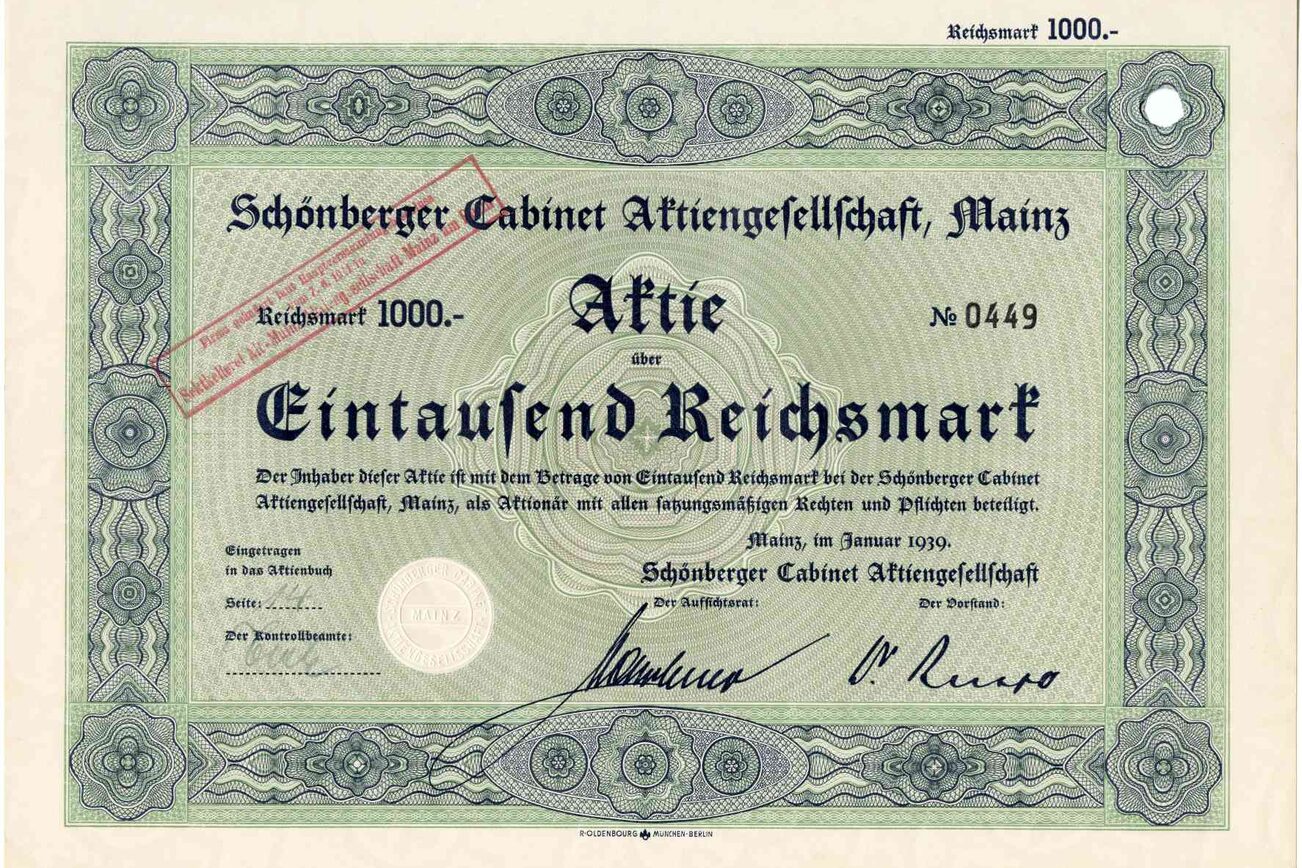
The share:
Bearer share with the number 0145. Format: 29.7 cm x 21.0 cm. Issued in January 1939 with a par value of 1,000 Reichsmark. The issue comprised 1,000 shares with a par value of 1,000 Reichsmark each, amounting to a total of 1,000,000 Reichsmark. A stamp on the share indicates the change of name in 1941 to "Sektkellerei Alt-Mainz Aktiengesellschaft Mainz am Rhein."
Schönberger Cabinet: Rise to become one of the leading German sparkling wine cellars
The wine trade was an important economic sector in Mainz in the 19th century. Abraham Schönberger founded a wine shop here in 1876 at Eisgrubweg 7. His older son Eugen (1871 to 1970) attended the Realgymnasium in Mainz and then completed a commercial apprenticeship. He joined his father's business and was appointed partner in 1902. His younger brother Arthur (1881 to 1931) gained experience in champagne production in France and joined the family business in 1906. From then on, the company focused exclusively on the production of sparkling wine and champagne. Production took place at Walpodenstraße 7, where the Goldhand sparkling wine cellars are located today.
Persecution under National Socialism
During the pogroms in November 1938, the Schönberger family's apartment was vandalized. Eugen Schönberger was forced to sell his company to the Wiesbaden wine merchant Wilhelm Ruthe. The couple, Eugen and Edith Schönberger, then emigrated first to France and then to the USA in 1941.
In 1948, the Schönberger family regained ownership of their company through restitution proceedings. However, business activities were not revived in the post-war period.
Sektkellerei Alter Eickemeyer Aktiengesellschaft

The share:
Bearer share with the number 1936 from the issue dated July 31, 1923, with a par value of 1,000 marks. Format: 25.2 cm x 18.7 cm. The issue comprised 10,000 shares with a par value of 1,000 marks each, amounting to a total of 10,000,000 marks. A complete sheet with ten profit share certificates for the years 1923/1924 to 1932/1933, together with a renewal certificate, supplements the share. The profit share certificates had to be presented to the credit institutions acting as paying agents for the payment of dividends.
Sektkellerei Alter Eickemeyer: Wine and sparkling wine from Mainz
The food industry played a significant role among the industrial sectors represented in Mainz. This included several sparkling wine producers. In addition to the outstanding entrepreneurs Christian Adalbert Kupferberg and Otto Henkel, the Eickemeyer company was also active in this sector. In addition to producing sparkling wines, it traded in wines and spirits. The conversion of C. Eickemeyer GmbH into a stock corporation in 1923 was intended to strengthen its capital base.
Production took place at Adlergasse 8 in Finthen, which was then still an independent municipality but was incorporated into the city of Mainz in June 1969.
The economic crash
The economic climate of the 1920s, which was largely characterized by inflation, had a negative impact on the company's development. Furthermore, competition with other German sparkling wine producers intensified. This led to the opening of composition proceedings in March 1929, which resulted in bankruptcy in May of the same year. A general meeting in August 1929 decided to liquidate the company.
Bond issued by the City of Mainz

The bond:
Bearer certificate with a nominal value of 2,000 marks for the bond dated January 1, 1923, with the number 000917. Format: 18.3 cm x 36.4 cm. The bond bore interest at 7 percent and was to be redeemed with a 2 percent premium by 1936. A complete sheet of interest coupons accompanies the document. The semi-annual interest was payable on January 2 and July 1 of each year upon submission of the corresponding interest coupons to the banks listed in the terms and conditions and to the Mainz city treasury. To secure the bond, the gas price was always set at a level that allowed the gasworks' surpluses to service the bond. The large-format
document is decoratively designed with illustrations of the Mainz double wheel as the main motif and background print.
The document is signed by the Mayor of Mainz, Dr. Karl Külb (1870 to 1943). He held office from 1919 to 1931. During his term of office, the city walls were converted into building land and, in 1930, Bretzenheim, Weisenau, Ginsheim, Gustavsburg, and Bischofsheim were incorporated into the city.
Use of the funds raised
The bond volume amounted to 140,000,000 marks. The funds raised were used exclusively for the expansion and conversion of the municipal gasworks. The plant, built in 1855 on Weisenauer Straße above the winter harbor, was no longer able to meet the increasing demand for gas. Therefore, a new gasworks was built in 1899 on the industrial site on the Ingelheimer Aue. Here, there was sufficient space for the necessary large-scale technical facilities.
Werner & Mertz Aktiengesellschaft in Mainz

The share:
Share from the issue of November 21, 1924. Format: 29.6 cm x 21.3 cm. The nominal value of the security was originally 1,000 Reichsmarks. In accordance with the currency reform regulations of 1948, the share was converted at a ratio of 1:1 to 1,000 German Marks.
The beginning of Erdal: candles for churches
On October 23, 1867, brothers Friedrich Christoph and Georg Werner founded the "Gebrüder Werner Wachswarenfabrik" (Werner Brothers Candle Factory). They produced liturgical candles and sealing wax at Mittlere Bleiche 16 in the Bleichenviertel district. Differences of opinion regarding capital resources and the company's growth strategy led to conflict between the brothers, resulting in Georg Werner leaving the company in 1872. In 1878, the wealthy Saarbrücken merchant Georg Mertz was accepted as a new partner. The company was then renamed Werner & Mertz. After the early death of Georg Mertz in 1887, his brother-in-law, the chemist Philipp Adam Schneider, took over the deceased's shares.
What does Erdal mean?
The company achieved its breakthrough with the groundbreaking development of a wax-based shoe polish, which was marketed under the "Erdal" brand from 1902 onwards. In 1905, the Werner family left the company, which has since been majority-owned by the Schneider family. After several fires and a temporary relocation to Erthalstraße (hence the name "Erdal"), the business was moved to the industrial area on the Ingelheimer Aue.
From a stock corporation to a limited liability company
In 1921, the company was converted into a stock corporation. Its steady expansion was characterized by the addition of industrial cleaning agents to its product portfolio, the acquisition of the manufacturer of "Blendax" toothpaste, and the development of foreign markets. Since the 1950s, Werner & Mertz has developed into a globally active chemical company. In 2024, the group's turnover amounted to EUR 611 million, with 1,169 employees across the group. The era of the public limited company ended in 1959 with the conversion to the legal form of a limited liability company.
Securities as collection items

Historical securities as collection items
<p>The term "historical securities" refers to shares or bonds that are no longer listed on the stock exchange, have become insolvent, or no longer exist. They are therefore generally no longer traded on the stock exchange and no longer have a market value. In this respect, historical securities are also referred to as nonvaleurs. Until the 19th century, the artistic design of securities was a way for companies to appeal to investors. This resulted in works of art that were intended to encourage investors to buy. The size of a security varies considerably. German shares were produced in large formats until the 1920s, after which they were mainly produced in DIN A4 format. Historical securities were only discovered as a collectible in the mid-1970s, and what had previously been considered "waste paper" became an object of collector's passion. There are approximately 10,000–12,000 collectors in Germany. Historical securities are primarily collector's items, and their value is determined by a combination of various factors, such as graphic and technical design, rarity, age, historical background, and condition. Most purchases are now made online, while rarities and unique items are usually offered at auction.
D-Mark and Euro: Securities in the 21st century
Starting in the early 1990s, the D-Mark stock market emerged as a distinct collecting category. The introduction of the euro led to a significant resurgence, as it marked the end of a distinct era. In addition, there is a stronger connection to and familiarity with the companies and products of the D-Mark era. All subsequent securities denominated in EUR or no-par shares are also included here. The printing of physical stock certificates has declined significantly since the mid-1990s. Moreover, the new currency, the euro, and the associated conversion of par values have led most German stock corporations to abolish individual certificates.
The treasure from the Reichsbank vault
Starting in 1942, all securities, among other items, were stored in the Reichsbank’s vault. Approximately 29 million securities thus survived the war virtually unscathed. Following reunification on October 3, 1990, ownership of most securities issued up to 1945 was transferred to the Federal Office for the Settlement of Unresolved Property Issues (BARoV).
In five auctions held in Berlin from 2003 to 2009, nearly 15,000 issues of German securities from the Reichsbank hoard were auctioned off. Prior to the auctions, the securities were perforated to invalidate them.
According to estimates, there were approximately 30,000 different German historical securities outside the Reichsbank Treasury; of these, about 7,500 are DM-denominated. The number of unknown issues from the Reichsbank Treasury exceeded 10,000.