Jewish Mainz - History
Here you will find information on the Jewish history of the state capital Mainz.
Magenza. One of the oldest Jewish communities in Germany.

The Jewish community in Mainz is one of the oldest in the German-speaking cultural area. A Jewish community already existed here in the 10th century. It gained fame through the work of its scholars, who made Mainz a religious and cultural center of Judaism in the Middle Ages.
Pogroms and Cultural Renaissance (The Era of the SchUM Cities)

However, cultural prosperity, a largely autonomous community life, and their own religious institutions, such as synagogues, mikvahs, butcher shops, and bakeries, should not obscure the fact that the social position of Jews in Mainz remained precarious throughout the Middle Ages. Foreign and domestic political tensions could quickly develop into an existential threat to the Jews. The very first crusade ended in disaster for the Jewish community of Mainz in 1096. In connection with the call for a military campaign against the Muslims to liberate the Holy Land, sentiment against the Jews, who were commonly branded as the murderers of Jesus, became radicalized. Incited fanatics and adventurers roamed the country in hordes with the aim of exterminating the Jews in their own country. The then Archbishop Ruthard evaded his obligation to protect the Jews of Mainz by fleeing, exposing them to slaughter. Well over 1,000 Jews were killed in the massacre, and Archbishop Ruthard was suspected of having enriched himself with their property.
The events during the plague epidemics of 1349 show how quickly general crises could erupt into aggression against Jews. The powerlessness to control this epidemic was expressed in wild speculation about the causes of the disease, in which the Jews were blamed as alleged well poisoners. The Jews of Mainz, who for almost a hundred years had been required to identify themselves by wearing a Jewish hat and a yellow cloth ring, also came under suspicion and were once again at the mercy of the angry mobs. Repeated expulsions of Jews took place during the turbulent times of the 15th century in Mainz. Power struggles within the city, severe financial hardship, and the loss of the city's freedom as a result of the war over the Archbishopric of Mainz shaped events. In 1471, all Jews were finally forced to leave the Electorate. Their property was confiscated by the state and the synagogue in Mainz was converted into a Christian chapel.
Jewish life in the ghetto
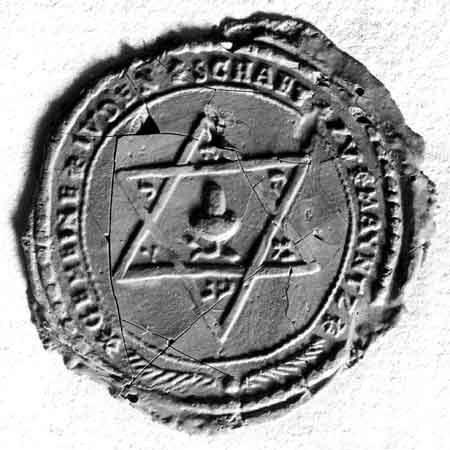
In the second half of the 16th century, Jews settled in Mainz again. They were granted a temporary, renewable right of residence in exchange for payment of so-called protection money, and thus represented a welcome additional source of income for the Elector. However, it took until the middle of the 17th century before a community of considerable size had established itself in Mainz again.
The growth of the Jewish community was viewed with great suspicion, however. The guilds in particular, which were still suffering from the poor general economic situation after the Thirty Years' War, complained about the increasing competition from the Jews. Elector Johann Philipp von Schönborn listened to their complaints and issued a decree on December 8, 1662, that had serious consequences for the Jewish residents of Mainz.
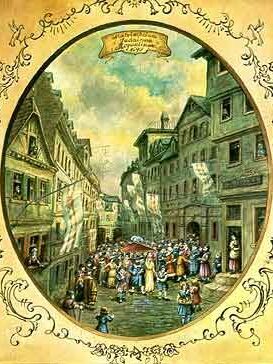
Already excluded from the guilds and thus from most trades, Jews were subjected to further economic restrictions, such as the prohibition of running "open shops" or the permission to trade only in certain goods. The number of Jewish families under protection was initially limited to 20, shortly thereafter to 10, and their future residential area was restricted to the Judengasse (Jewish Alley), which already existed at that time and had to be closed off on both sides. The numerical restriction on the number of Jewish families allowed in Mainz could not be maintained and was soon raised to 101 families. However, the restriction of the residential area to the alley remained in place. Over the decades, the right of residence was extended to a total of two alleys, the closed Judengasse and the open Judengasse on its eastern side (from the middle of the 19th century: Vordere and Hintere Synagogengasse), which ran parallel to each other and were located between Klara- and Löwenhofstrasse. As a consequence of the steadily growing Jewish community, which numbered an estimated 543 people around 1790, living space in the Jewish quarter became increasingly scarce. Strikingly narrow houses, which were built taller and deeper than average, stood close together here.
Jews of Mainz in the Age of Enlightenment
The philosophy of the Enlightenment, with its principle of equality for all people, had its first impact on the Jews of Mainz during the reigns of Electors Emmerich Josef von Breidbach-Bürresheim (1763-1774) and Friedrich Karl Joseph von Erthal (1774-1797). Jews were given permission to live outside the Jewish quarter, they were allowed to study medicine at Mainz University, and Jewish children were permitted to attend Christian schools for the first time. Legal equality with Christians came with the French occupation of 1792/93 and 1798-1814 for the Jews of Mainz, who nevertheless remained suspicious of their new rulers.
Authoritarian interference in Jewish community affairs and the introduction of Napoleon's discriminatory decree of 1808, which made it compulsory for Jews to obtain a so-called "morality patent" in order to engage in trade, confirmed this mistrust. After the Wars of Liberation and the end of the Napoleonic era in Europe, the legal situation of the Jews in Mainz appeared much more favorable than that of their neighbors in Frankfurt. However, some restrictions remained in place. The "Shameful Decree" of 1808 was not repealed until 1847, and Jews were denied entry into public service for a long time to come.
The emancipation of the Jews
The Jewish emancipation movement, which came to a legal conclusion in Germany after almost a hundred years with the founding of the German Empire in 1871, was accompanied by profound changes in Jewish life, which also left a clear mark on Mainz. At first, Christians were still far from ready to tolerate Jewish neighbors, so the Jewish quarter remained the preferred residential area. Only gradually did Jews settle in the surrounding areas of Flachsmarkt and Bleichenviertel. After the opening of the ghetto, individual Jews also began to take an interest in the new ideas of the Enlightenment and, under this influence, critically examined the traditional view of Judaism.

In order to meet the requirements of the new bourgeois society, Michael Creizenach, a Jewish educator and later teacher at the famous Philanthropin school in Frankfurt, founded a school in Mainz in 1814 to teach Jewish students previously neglected secular knowledge and foreign languages.
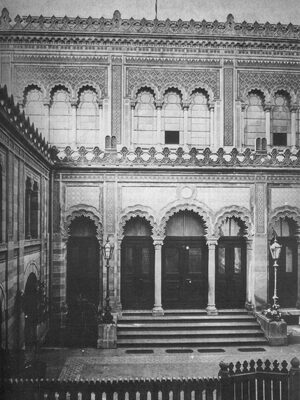
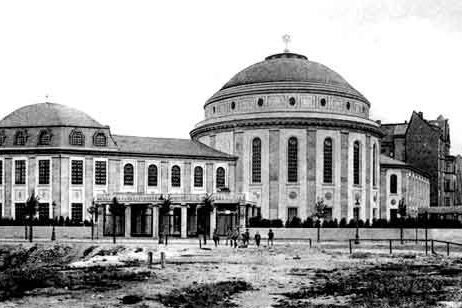
Isaak Jakob Bernays, from Mainz, who became rabbi in Hamburg in 1821, is known for his religious reform efforts. However, some of the innovations he sought to introduce were too far-reaching for part of the Jewish community in Mainz, which remained committed to traditional Judaism, leading to a split in 1849. The liberal "Israelite Religious Community" consecrated its synagogue in Vordere Synagogenstraße in 1853, followed in 1912 by the magnificent new building of the main synagogue in Hindenburgstraße.
At the corner of Flachsmarktstraße and Margaretengasse, the orthodox "Israelitische Religionsgesellschaft" (Israelite Religious Society) built its own synagogue in 1856, which was replaced in 1879 by a larger building in Moorish style, designed by the city architect Eduard Kreyßig. Nominally, there remained a single Jewish community in Mainz. However, the two groups led their own community lives, each with their own facilities.
National Socialist takeover and the end of Magenza
When the National Socialists seized power in Germany in 1933, Mainz had a vibrant Jewish community with around 2,600 members. Their disenfranchisement progressed rapidly. After dismissals from public service and the boycott of Jewish businesses, the Nuremberg Race Laws followed in 1935, which deprived Jews of German citizenship. Jewish students had to leave their schools and were denied access to higher education and training. Jewish owners were increasingly pressured to transfer their businesses, companies, and houses—usually far below their value—to "Aryans." Numerous people were forced to emigrate.

During the pogrom night of November 9–10, 1938, the synagogues on Hindenburgstraße and Flachsmarktstraße were looted and set on fire. The following morning, there were numerous attacks on Jewish shops and homes, as well as assaults on individuals. Dozens of Jewish men were arrested and sent to concentration camps. After the war began, it became increasingly dangerous for Jews to appear in public, as they were required to wear the yellow "Jewish star" in Germany from 1941 onwards. They were also increasingly deprived of their freedom of movement. They were forced to live crammed together in so-called "Jewish apartments." They had to hand over their radios, typewriters, cars, jewelry, all silver objects, and fur coats. They were no longer allowed to own telephones or pets, use public transportation, visit swimming pools, sit on park benches, or be treated by non-Jewish doctors. They received smaller food rations than the rest of the population and were only allowed to shop at certain times, to name just a few examples of the harassment and restrictions.
Oppression and humiliation were ultimately followed by extermination. In March and September 1942, more than 1,000 Jewish men, women, and children, including many elderly people, were deported to Poland and the Theresienstadt ghetto in three large transports. On February 10, 1943, the last transport left Mainz for the concentration camps. When American troops liberated Mainz in 1945, only a few Jews living in so-called mixed marriages remained. It is estimated that between 1,300 and 1,400 Jews from Mainz were murdered, innocent victims of Nazi racial fanaticism.
Development after 1945
After the war, only a few emigrants returned to their hometown of Mainz. The memories of the humiliations and persecution they had endured, as well as the crimes they had witnessed, were too painful. Twenty-four survivors of the Theresienstadt concentration camp were brought back to Mainz by bus. Among them was Max Waldmann, the first president of the Jewish Community, which was newly formed on October 17, 1945. Of the new community members, only a few were from Mainz or Rheinhessen. Making a fresh start during a time of economic hardship and with the horrors of the past still fresh in their minds was difficult.

Over the years, dialogue was also reestablished with Jewish emigrants from Mainz who now live scattered across the globe. Some came to Mainz on private visits to visit the graves of their relatives, to revive old friendships, or to show their children and grandchildren their former hometown. After the city council approved the necessary funds, encounter weeks were held in 1991, 1992, 1993, 1995, 1998, and 2001, during which several hundred emigrated Mainz Jews were invited to spend a week in their hometown.
However, not everyone was able to return to Mainz. Some had died in the meantime or were no longer able to make the long journey due to their age and state of health. Others refused to visit their old home again because of their painful experiences. The overall positive response to the reunion weeks shows that they made a significant contribution to reconciliation, which must be continued—while remaining aware that reparations are not possible. The city of Mainz is currently still in contact with a large number of emigrated Mainz residents and their descendants all over the world.