
City walk: 80th anniversary of the bombing of Mainz
80 years ago, on February 27, 1945, the people of Mainz experienced one of the heaviest air raids on their city during the Second World War. 1,200 people died that day.
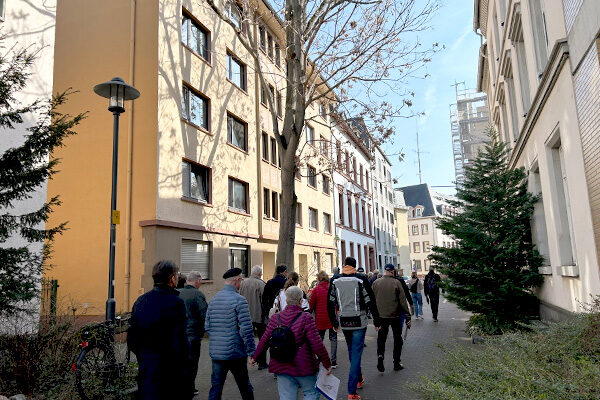
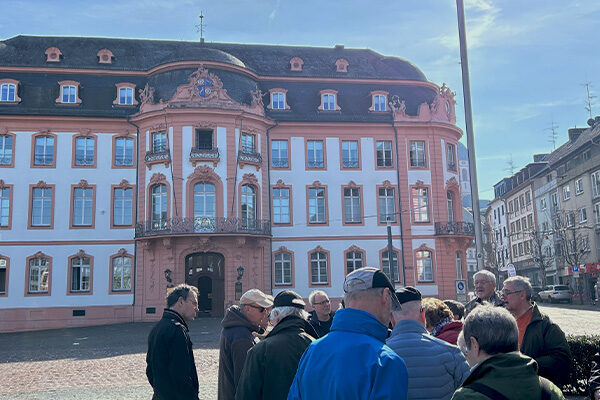
To mark the anniversary, the state capital of Mainz organized free city walks with AZ editor Michael Bermeitinger. The people of Mainz showed great interest in learning about the city's history and this tragic anniversary. Due to high demand, the two tours originally planned turned into a total of four walks.
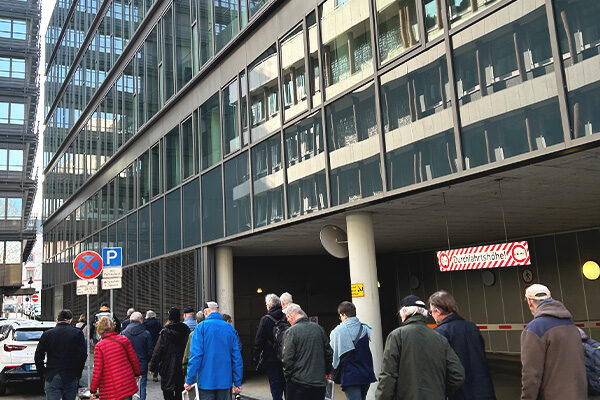
"Fire rained into the houses"
The tour began at the Große Bleiche Stadthaus, where Michael Bermeitinger first gave an introduction to the topic and distributed folders containing photos from his archive to the participants. The photos are important historical records from that period that illustrate the scale of the bombings. Despite the ban on photography—which was punishable by imprisonment—there were people who dared to take photos anyway.
“The attack swept diagonally across the city; the bombers flew from the Gonsbach Valley toward the tip of the Main River. The British strategy was to reduce Mainz to rubble and ashes with high-explosive and incendiary bombs—fire rained down from above into the houses,” reported Michael Bermeitinger.
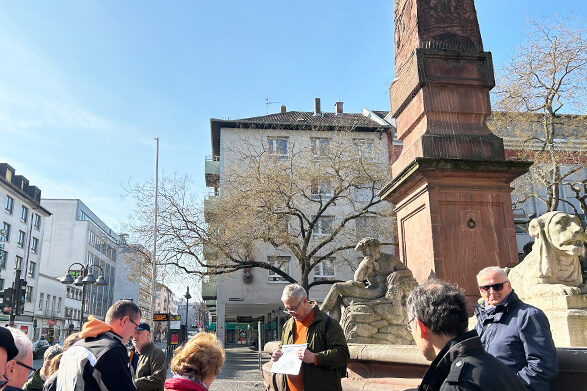
Ruins still stood until the 1960s
The extent of the destruction at that time was so enormous that ruins remained standing in Löwenhofstraße, which had been hardest hit by the attack, until the 1960s. Where new buildings now stand everywhere, bombs struck and houses burned down. "The Kronenberger bank was miraculously hardly destroyed. It was one of the last Jewish commercial buildings, which was demolished a few years after the war. Today, a Commerzbank branch stands on the same site," explained Bermeitinger.
The walk continued through Große Bleiche to Neubrunnenplatz. There, he described the effect of the firestorms, in which people died on the open streets due to the enormous heat.
No bunkers in Mainz
The tour continued across Münsterplatz to the Altmünsterkirche, which was destroyed in 1944. Mainz did not have any large bunkers, so the residents of the old town sought refuge in cellars such as the Kupferbergkeller of the Kästirch, the Aktienbrauereikeller, or the Sektkeller. "Many people even remained underground permanently during the last weeks of the war to seek protection," Bermeitinger reported.
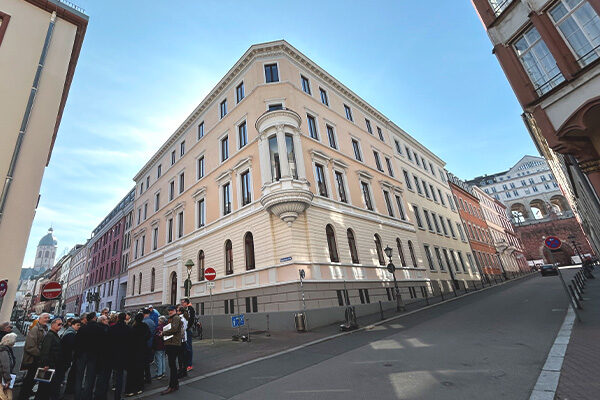
The walkers paused at the intersection of Beidenbachstraße and Emmerich-Josef-Straße. Here stands a house that was used by the Nazis as a gathering place for Jews. More than 100 people were crammed into this house before being deported to Nazi concentration camps.
Schillerplatz and Große Bleiche were most affected
At Schillerplatz, Michael Bermeitinger told participants that Mainz had been 80 percent destroyed at that time. Some areas had even been completely destroyed. Aerial photographs show that Schillerplatz and Große Bleiche were the worst affected. The vertical photos were taken by British soldiers who documented the destruction in Mainz just a few days after the attack. This allows us to understand today just how enormous the damage was at the time.
The destruction and reconstruction resulted in the loss of the original neighborhood structure of Mainz's old town, with many narrow streets being widened and merged. The tour and the images impressively showed how much Mainz changed as a result of World War II and the Nazi dictatorship, and served as a reminder of the many lives lost.
Further information
Contact us
Address
Public Relations Division
Stadthaus Große Bleiche
Große Bleiche 46
55116 Mainz
Postal address
55028 Mainz
Telephone, fax and e-mail address
- +49 6131 12 ext. 2382
- +49 6131 12 ext. 3819
- oeffentlichkeitsarbeitstadt.mainzde