
Covering and planting tree grates
Trees in the city fulfill important functions: They have a positive effect on the urban climate, improve the ecological conditions in their surroundings, serve to protect species and characterize the cityscape.
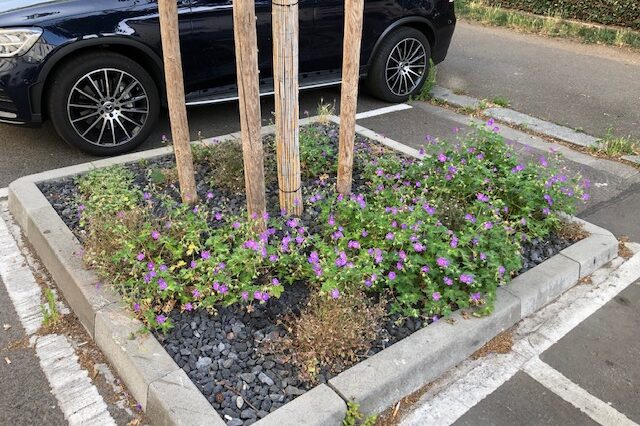
The administration repeatedly receives inquiries about the supposed "gravel" in the tree pits. Of course, the mineral tree pit coverings should not be confused with the ecologically inferior gravel gardens found in private homes. In order to provide tree plantings with the best possible water supply, a layer of mineral mulch several centimeters thick, e.g., made of lava, is a suitable means of absorbing water, transferring it directly to the soil, keeping natural evaporation low, and maintaining stable soil air exchange. In addition, this layer ensures that the soil underneath is not compacted under load. Especially in the first two to three years, this porous and dimensionally stable covering helps young trees to get off to a good start, particularly in inner-city areas where tree pits are exposed to high loads. Once the young trees are established and firmly rooted in their new location, the city gardeners also help with initial planting or sowing, thereby promoting natural greening in the tree pits.
Basic information on tree pit planting can be found in a variety of publications on the Internet. Questions about planting in tree pits and care by citizens can also be clarified with the experts at the Parks and Environment Office at 06131 12-3197 or 06131 12-2801.
Ultimately, the tree should start its long life in good health and the tree pit beneath it should be planted and serve as a habitat and food source for many insects in the urban landscape.