Women's life in Magenza
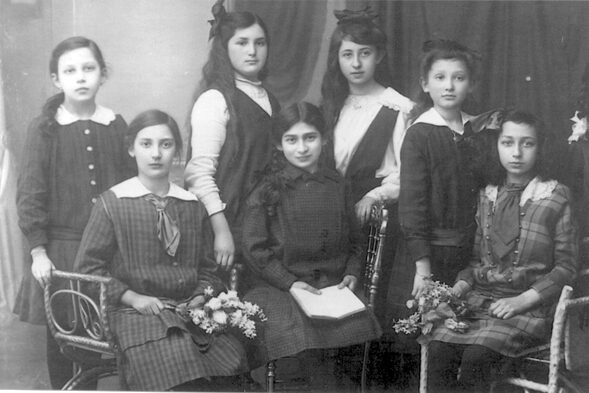
With our historical works, we also commemorate (mostly long forgotten) female personalities who were born, lived and worked here or died here. They include women from all areas of society and, of course, Jewish women from Mainz.
Brochure: Women's life in Magenza
"Women's Lives in Magenza" – New edition of brochure published by Women's Office offers insights into the lives and fates of Jewish women and girls in Mainz
Magenza, Jewish Mainz, was and always has been female, and 1,700 years of Jewish life in Germany also means 1,700 years of Jewish women's lives in Germany.
In keeping with this anniversary year 2021 and January 27, the day of remembrance for the victims of National Socialism, the Women's Office of the state capital Mainz has completely revised and reissued the publication "Women's Lives in Magenza," which first appeared in 2010.
The 100-page brochure features over 70 portraits of Jewish women and girls from the Mainz women's calendars since 1991 and texts on the history of Jewish women in the city.
The biographical journey through time spans from the 14th to the 20th century. It ranges from Bruna, a learned woman from the late Middle Ages, to Ellen Berta Marxsohn, who was murdered in Auschwitz in 1942 at the age of 13.
They had many professions, were singers, musicians, writers, doctors, lawyers, housewives, schoolgirls, and much more.
For some of the women and girls portrayed, their religious affiliation was important and shaped their identity, while for others it played no role. And yet, regardless of the era in which they lived, their lives were decisively influenced by the fact that they came from Jewish families, saw themselves as Jewish, or were viewed as Jewish by others.
Most of the portraits are dedicated to women and girls who were murdered or driven into exile during the Nazi era, but even the stories of those who lived in other times were not free from anti-Semitism.
Reinhard Frenzel, who worked as a teacher at the Frauenlob Gymnasium and researched the lives and fates of many Jewish students at the Höhere Mädchenschule, is the author of a whole series of portraits. Further biographies were written by Eva Weickart, head of the Women's Office. Texts on Jewish women's history by Martina Trojanowski, also from the Women's Office, are also included.
The brochure is available free of charge in the foyer of the Stadthaus Große Bleiche (Große Bleiche 46/Löwenhofstraße 1, 55116 Mainz). It can also be sent by mail for a fee of €1.55 in stamps.
It is also available for download here for anyone interested:
Exhibition: They lived next door
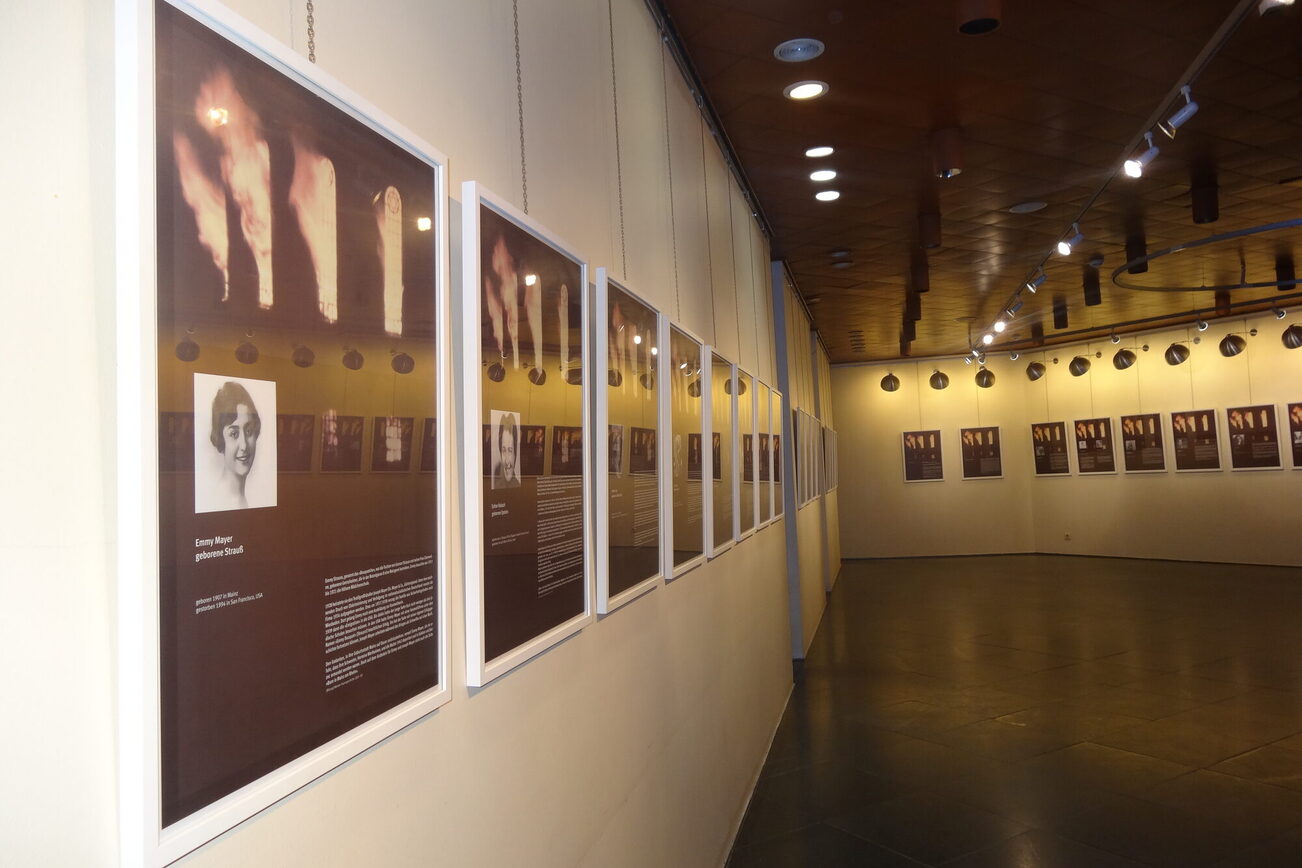
"They lived next door: Jewish women from Mainz persecuted under National Socialism" is the title of the exhibition jointly organized by the Women's Office and the City's Cultural Office, which was opened by Mayor Michael Ebling at 6 p.m. on January 22, 2015, in the City Hall Gallery and ran until March 21, 2015. The national and international day of remembrance on January 27 commemorates the liberation of the Auschwitz concentration camp. 2015 marked the 70th anniversary of this event.
The main focus of the events in Rhineland-Palatinate was the persecution of women under National Socialism. The Mainz exhibition addresses this topic in a special way. For 25 years, biographies of persecuted and murdered Jewish women from Mainz have been included in the calendar "A Look at Mainz Women's History." Forty-nine biographical memories from 25 years of women's calendars were now the focus of the exhibition in the Rathausgalerie.
Especially for the exhibition and the 70th anniversary of the liberation of Auschwitz, the Cultural Office has also compiled a photo documentation of the Stolpersteine (stumbling stones) laid so far for female victims of National Socialism in Mainz. On many sidewalks in Mainz, the stumbling stones are a reminder that the women, men, girls, and boys persecuted under National Socialism once had a home, that they lived next door.
A new edition of the brochure "Frauenleben in Magenza" (Women's Lives in Mainz) has also been published to coincide with the exhibition opening. Published by the Women's Office, the brochure offers a broad biographical and historical overview of the lives and work of Jewish women in Mainz.