Hornbeam
The hornbeam is native to all of Europe and parts of Western Asia. In gardening and landscaping, the hornbeam is often used for hedges because it tolerates pruning extremely well. It is often the only plant in the minimalist gardens of the very formal single-family and multi-family homes that are currently being built. In the open countryside, it is often used in windbreaks and is one of the trees that provide shelter for birds. Carpinus betulus is very frost and shade tolerant. It can withstand summer heat and drought as well as short-term flooding.
- Origin: Europe, Western Asia
- Growth height: 15–20 meters
- Leaves: alternate; ovate to elongated-elliptical; slightly serrated leaf margins; bright yellow autumn color
- Flower: with leaf budding; yellow male and green female catkins
- Fruit: September; small nuts sitting in bracts, which disperse them by flying
- Soil/location: undemanding; prefers fresh soil; shade tolerant
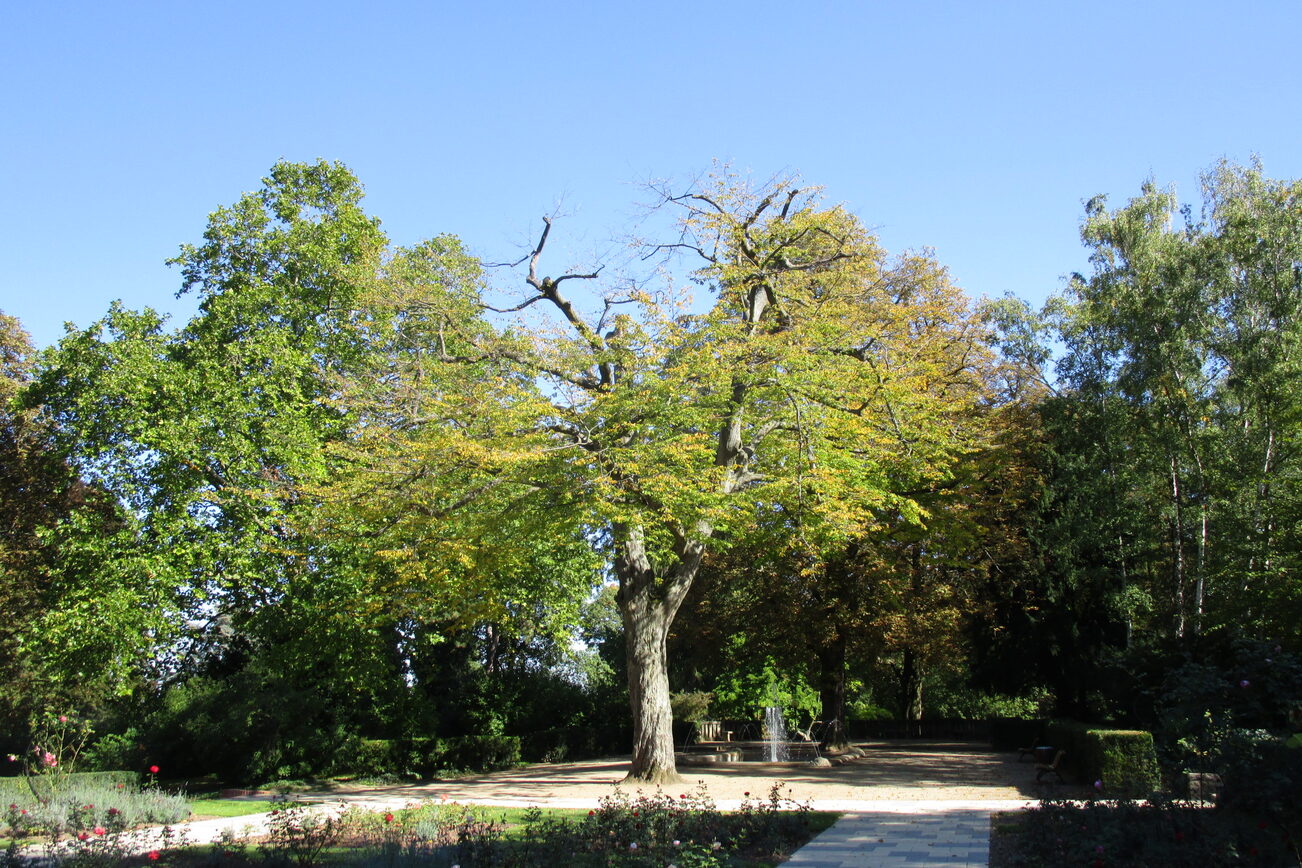
- Special feature: The hornbeam in Mainz City Park, in the immediate vicinity of the renovated fountain in the rose garden, is still a very impressive tree despite its unmistakably advanced age. Even though it is losing ground year after year and the occasional pruning is necessary for traffic safety reasons.
Similar to the Zelkove, the large hornbeam in the rose garden is listed by the German Dendrological Society in its list of so-called "Champion Trees" (https://www.ddg-web.de) as the largest known of its kind in Rhineland-Palatinate. The national record holder in this category is a hornbeam in the castle park in Bodman-Ludwigshafen on Lake Constance in Baden-Württemberg.