
Inventing-Deceiving-Revealing?! - Mainz medieval forgeries
A virtual exhibition of the Mainz City Archive together with students of the History Department of Johannes Gutenberg University Mainz.
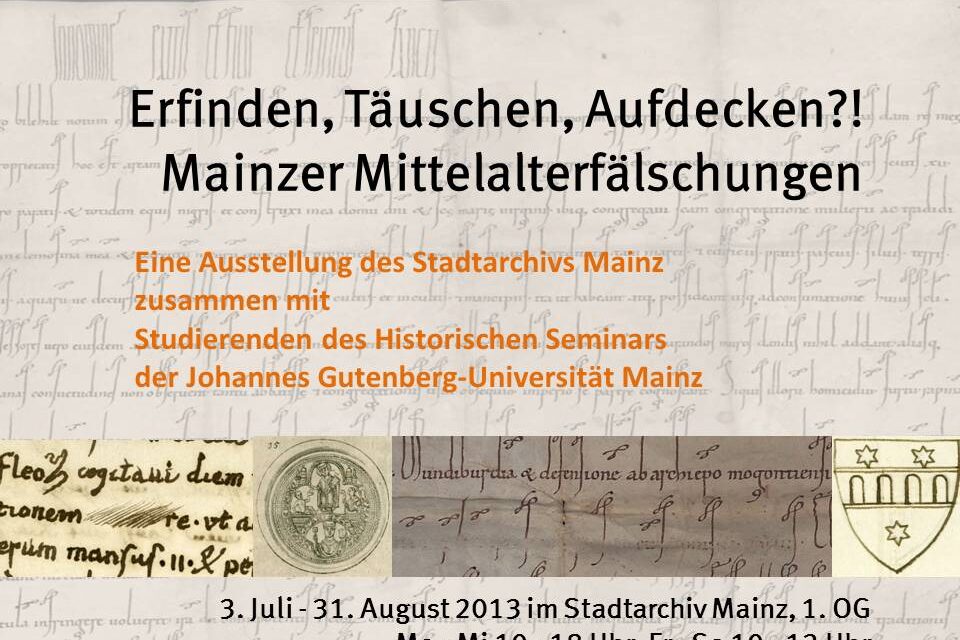
Preliminary remark
Preliminary remark
The exhibition originated from an archival education exercise organized by the Mainz City Archives in the summer semester of 2013 with students from the History Department of Johannes Gutenberg University. After the exhibition was presented in the stairwell of the City Archives from July 3 to August 31, 2013, the City Archives is now publishing texts and images on the Internet due to the great interest it generated. Against the backdrop of current discussions about authorship and evidence in science, the arts, and journalism, it is worth taking a look back at the centuries that are considered the age of forgeries par excellence: the Middle Ages.
The exhibition "Invent, Deceive, Uncover?!" therefore presents examples from the fields of diplomatics, epigraphy, art history, and numismatics that are forgeries both from and about the Middle Ages in Mainz. Here, viewers can become explorers themselves and learn about the craft of forgery. How can you recognize forgeries? Are all forgeries really forgeries? And who were the forgers and for what purpose did they forge?
Editor: Prof. Dr. Wolfgang Dobras
Authors:
Catrin Abert
Patrick Beaury
Lilli Braun
Marie Dax
Stephanie Eifert
Jean Kiltz
Janina Kühner
Tim Möst
Anika Rech
Daniel Schildger
Yannick Weber
Introduction
Introduction
In 1983, there was a scandal at Stern magazine. The "Hitler diaries" "discovered" by reporter Gerd Heidemann and hastily published by the editorial team turned out to be forgeries by militaria dealer and painter Konrad Kujau. A spectacular press scandal that was unparalleled—or was it? A look back at history shows that forgeries have occurred repeatedly over the centuries. The Middle Ages in particular are considered the age of forgeries. Half of the documents from the 6th and 7th centuries are believed to be forged, falsified, or counterfeit. And even from the time of Charlemagne, a third of the documents can still be considered fabricated. One of the most famous medieval forgeries is the so-called Donation of Constantine. According to this document, Emperor Constantine the Great is said to have granted Pope Sylvester I sovereignty over Rome and the Western world around 330. The popes used this to substantiate their claim to primacy in Christendom. In the 15th century, scholars uncovered the forgery based on linguistic characteristics. Research has since proven that the deed of donation was written by clergy in Rome in the second half of the 8th century. Ecclesiastical institutions in particular stood out among medieval forgers, as they were able to use forgeries to defend themselves non-violently against attacks by secular rulers and their instruments of power. The forgers may have appeased their conscience by arguing that they were entitled to use a "pious" lie for a good, i.e., ecclesiastical-religious purpose. However, regardless of the forgers' concept of truth and sense of justice, forgeries were already subject to criminal law in the Middle Ages. As early as the 13th century, ecclesiastical law contained advice on how to verify the authenticity of a document and penalties for forgers. The law book known as the Schwabenspiegel, written at the end of the 13th century, stipulated that a "priest" convicted of forgery should be handed over to the bishop so that he could strip him of his spiritual dignity. He was then to be handed over to the secular judge and have his hand cut off, as in the case of a layman. Medieval criminal law dealt even more rigorously with coin counterfeiters: they faced being boiled in a cauldron. A look at the city and archbishopric of Mainz also shows how widespread forgeries were. The edition of all Mainz documents from 628 to 1200, edited by Manfred Stimming and Peter Acht, comprises a total of 1,137 items. Of these, a total of 174 documents, or approximately 15%, turn out to be forgeries, with the 12th century accounting for the majority. While 77 forgeries can be verified for the centuries up to 1099, the 12th century alone accounts for 97 forgeries. However, these figures need to be differentiated: although all 174 forgeries claim to originate from the Middle Ages, only 105 were actually produced in the Middle Ages, mainly by monasteries and foundations in the 12th and 13th centuries. No fewer than 69 forgeries were produced by early modern forgers, particularly those active at the end of the 18th and beginning of the 19th centuries, who were overzealous and ambitious historians. Lit.: Horst Fuhrmann, Fälschungen über Fälschungen, in: ibid., Einladung ins Mittelalter. Munich 2009, pp. 193-236; Peter Rückert (ed.), Alles gefälscht? Verdächtige Urkunden aus der Stauferzeit. Archivale des Monats März 2003 im Hauptstaatsarchiv Stuttgart. Stuttgart 2003 Lilli Braun
Altmünster deed from 635

The oldest Mainz document from 635 - a forgery of the Altmünster monastery from the 12th century
In a parchment document dated April 22, 635, in the 14th year of King Clovis' reign, Bilhildis (later venerated as a local saint) announces that she has built a house of worship and founded an association of pious women on a piece of land in Mainz that she acquired from her uncle, Bishop Rigibert of Mainz.
This so-called founding document of the Altmünster monastery (which is clearly only documented from 817 onwards) arouses suspicion simply because of its inconsistent dating. This is because none of the historically verified bearers of this name can be reconciled with the King Clovis mentioned in the dating: King Clovis I (481-511) reigned too early, Clovis II (639-657) and Clovis III (691-694) too late; the latter also reigned too briefly, with only four years of rule.
The fact that it is a forgery can be seen purely from the form of the script. This clearly dates from the 12th century, as a comparison with a genuine Merovingian document from King Theuderich III from the year 688 (see below) proves. In contrast to the narrow, almost indecipherable Merovingian script, the Altmünster document is not as dense, but appears more open and is characterized by long ascenders with flourishes, as is typical of the High Middle Ages.
In addition to the formal aspects, there are also reasons related to content that argue against dating the document to the Merovingian period. This is because the document exempts the monastery from civic burdens such as night watches and taxes, which reflect conditions that only existed with the emergence of an independent civic community in the course of the 12th century. The rejection of these civic demands was probably also a motive for the forgery; it was presumably based on a genuine document from the early 8th century, now lost, in which these additions were incorporated to secure the rights of the monastery.
Even though the document was not written very carefully (almost an entire line in the middle of the document has been erased), the nuns attached great importance to it: the Mainz historian Nikolaus Serarius reported in 1604 that the document hung above the high altar of the monastery church for all to see.

Comparative example
King Theuderich III certifies a donation to the monastery of St. Denis, October 30, 688 (facsimile in W. Arndt / M. Tangl, Schrifttafeln zur Erlernung der lateinischen Palaeographie, Berlin 1904, issue 1, plate 10).
Print: Manfred Stimming (ed.), Mainzer Urkundenbuch Vol. 1: Die Urkunden bis zum Tod Erzbischof Adalberts I. (1137). Darmstadt 1932, No. 2b.
Lit.: Brigitte Flug, Äußere Bindung und innere Ordnung. Das Altmünsterkloster in Mainz in seiner Geschichte und Verfassung von den Anfängen bis zum Ende des 14. Jahrhunderts. With document book and appendix of persons (on attached CD-ROM) (Geschichtliche Landeskunde 61). Stuttgart 2006, pp. 30-42; Heinrich Wagner, The Mainz Bilihild Document of April 22, 734, in: Mainzer Zeitschrift 103 (2008), pp. 3-14; Hans-Peter Schmit, Die heilige Bilhild und das Altmünsterkloster in Mainz: zur Erfindung einer frühmittelalterlichen Heiligenlegende, in: Archiv für mittelrheinische Kirchengeschichte 61 (2009), pp. 11-60.
Janina Kühner
Jean Mabillon

The art of distinguishing the true from the false - Jean Mabillon and the beginnings of diplomatics
The beginning of scientific document criticism is marked by the work "De re diplomatica" by the French Benedictine Jean Mabillon (1632-1707) from 1681, which appeared posthumously in a second and expanded edition in 1709. In it, Mabillon dealt with the subject systematically and theoretically for the first time: in five chapters, he not only discussed the structure and characteristics of documents, but also included numerous text examples and facsimile copperplate engravings of documents to verify his judgments.

The image shows a page from the fifth part, in which Mabillon discusses the description of rulers' monograms, using the example of a document from 1167 by the French king Louis VII (reigned 1137-1180). The explanation reads: "We have included various monograms of Louis VII, as we find them in various documents, so that no one else will consider them suspicious if they do not correspond to the first monogram (used on the document from 1167)." Mabillon's method is clear: when judging the authenticity of a document, comparison is essential.
Wolfgang Dobras
Imperial charter of Frederick Barbarossa

Unauthenticated, therefore suspicious? A document by Emperor Frederick Barbarossa for the clergy of Mainz from 1173
In this document dated July 2, 1173, Emperor Frederick I Barbarossa confirms the clergy of the city of Mainz's right to freely dispose of their movable property by will. The background to this legal act was the dispute over the will of a canon of St. Victor's Abbey, who had bequeathed his property to the abbey and thus disregarded the supposed claims of his relatives.
In terms of form and content, the Mainz document resembles a genuine document (now only preserved in copy form) from 1165 for the church in Worms, in whose favor the emperor had decided a similar legal dispute. What is striking about the Mainz piece is, on the one hand, the absence of a seal, even though the text announces a golden bull as a means of authentication (for its appearance, see the example of a golden bull of Emperor Frederick I in the Coin Cabinet of the Berlin State Museums – Prussian Cultural Heritage Foundation: http://www.smb.museum/ikmk/object.php?id=18225152 )..
Secondly, the monogram with the emperor's initials in the center differs from the usual symbols (see the image comparison in Exhibit 03a). However, it is no longer possible to verify whether the monogram corresponded to the Worms model due to the loss of the original Worms document.
The document from 1173 is preserved in the archives of St. Peter's Abbey in Mainz and can also be attributed to a scribe working there based on the handwriting. However, researchers have been able to identify one forgery among the documents written by him. Does this allow us to conclude that this document is also a forgery? What is certain is that the imperial chancellery was not involved in its execution. Also striking is the absence of any references to the events described in the document in sources from St. Victor's and other Mainz monasteries.
Nevertheless, this is probably not a forgery. Rather, it is a recipient's fair copy that was never completed. In this case, St. Peter's produced this document, including the imperial monogram, in advance so that it could later be sealed and authenticated by the emperor. We can only speculate as to why this did not happen.
Nevertheless, the document became legally binding in the Mainz church even without certification. On January 12, 1193, Provost Burchard of Jechaburg in Thuringia granted his canons free disposal of their estates and had this confirmed by Archbishop Konrad of Mainz in 1196. It is probably no coincidence that it was Provost Burchard who certified the freedom to make a will in 1193, as he was also provost of St. Peter's in Mainz in 1173. Whether his decision was an indirect reference to the 20-year-old imperial document or a renewed attempt to address the issue remains unclear.
Print: Peter Acht (ed.), Mainzer Urkundenbuch Vol. 2,1: Die Urkunden seit dem Tode Erzbischof Adalberts I. (1137) bis zum Tode Erzbischof Konrads (1200). Darmstadt 1968, No. 349.
Lit.: Peter Acht, Probleme der Mainzer Urkundenforschung. Tradition and Forgery in St. Peter's Abbey in Mainz. In: Aus Verfassungs- und Landesgeschichte. Festschrift für Theodor Mayer, Vol. 2, ed. by Heinrich Büttner. Lindau 1955, pp. 403-423.
Tim Möst
Imperial charter: The monogram comparison


Unauthenticated, therefore suspicious? A document of Emperor Frederick Barbarossa for the clergy of Mainz from 1173. The monogram comparison
The upper and lower monogram designs originate from the imperial chancellery, while the middle monogram was produced by St. Peter's Abbey in Mainz. The middle monogram from St. Peter's differs considerably in some respects from both the upper monogram, which is common, and the lower monogram, which is rare.
The first illustration shows the usual monogram of Emperor Frederick I on a document from 1158. It comes from: Digitale Urkundenbilder 4: Kaiser- und Königsurkunden der Staufer (1138-1268) [Digital Document Images 4: Imperial and Royal Documents of the Staufers (1138-1268)], edited by Walter Koch and Christian Friedl, Leipzig 2010, plate 6. The second illustration comes from a document in the Mainz City Archives and shows the monogram of an imperial document from 1173. The third illustration shows Frederick's monogram on a document from 1168. The illustration comes from the Research Institute Photo Archive of Older Original Documents, Marburg, ZNr. 1890 (E 614).
Gutenberg and St. Viktor
A member entry under suspicion - Gutenberg and his relationship with St. Viktor's Abbey in Mainz
There is hardly a more famous "Meenzer Bub" (boy from Mainz) than Johannes Gutenberg, whose real surname was Johannes Gensfleisch. Today, this man, whose invention is regarded as the threshold to the modern age, is known to everyone. But back then, things were different. His invention only gained the global significance we associate with it today after his death. His death is usually dated to February 3, 1468, in Mainz. An important source for this is a strip of parchment exhibited in the Gutenberg Museum (see illustration).
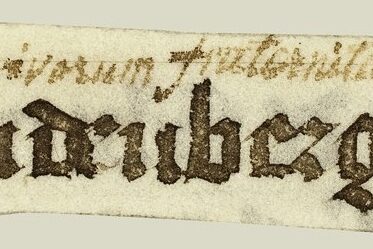
It bears the inscription "hengin Gudenberg ciuis mag[untinus]," thus identifying Gutenberg as a citizen of Mainz. The strip was found in the estate of Franz Joseph Bodmann, a Mainz university professor, legal historian, and librarian who lived and worked in Mainz at the end of the 18th and beginning of the 19th century. After his death, however, it quickly became apparent that his collections contained forgeries he had made himself. This parchment strip was also suspected of being one of Bodmann's new creations.

The image above shows the brotherhood book of St. Victor's Abbey. From the outset, researchers agreed that the strip belonged to the brotherhood book of St. Victor's Abbey shown here, which was once located in what is now the Mainz-Weisenau district. The book was created in 1384 when the burial brotherhood renewed its rules. The first part contains the list of living members, the second part the list of deceased members. The strip with Gutenberg's inscription comes from the second part. Bodmann had simply cut it out, an act of document damage that is unimaginable for today's archivists and historians. This act and the discovery of the strip in the estate of the "prejudiced" Bodmann led to the suspicion that the excerpt, or more precisely, the inscription on it, had been forged by Bodmann.
However, historian Gottfried Zedler not only claimed that Bodmann had added the inscription to the strip himself, but also accused him of writing Gutenberg's name, which also appeared in the list of living members, into the book. Bodmann then shaved off the name, i.e., scraped it off, to increase the authenticity of the passage. It was Karl Stamm who, by applying the so-called luminescence process, which is based on irradiation with ultraviolet light, was able to make the different layers of writing visible and determined that it was impossible for Bodmann, with his modest means, to forge the entry (line between "Hilla famula" and "Anna de Cronenberg," marked with a red arrow: "Hengin Gudenberg civis Maguntin[us]") in this way. Today, there is no question that Gutenberg was a lay member of the Brotherhood of St. Victor and that the brotherhood kept meticulous records of its members.
Print: Karl Schorbach, Die urkundlichen Nachrichten über Johann Gutenberg, in: Otto Hartwig (ed.), Festschrift zum 500jährigen Geburtstage von Johann Gutenberg, Mainz 1900, pp. 133-256, here no. 26, pp. 222-226.
Lit.: Gottfried Zedler, Gutenberg und seine Zugehörigkeit zum Mainzer St. Viktor-Stift – Eine Fälschung Bodmanns? (Gutenberg and his affiliation with the St. Victor Foundation in Mainz – A forgery by Bodmann?), in: Mainzer Zeitschrift 35 (1940), pp. 49f.;
Karl Stamm, Gutenberg und seine Zugehörigkeit zum Mainzer St. Viktor-Stift – Eine Fälschung Bodmanns? (Gutenberg and his affiliation with the St. Victor Foundation in Mainz – A forgery by Bodmann?). A statement on Zedler's claim in Mainzer Zeitschrift 35, 1940, pp. 49/50, in: Mainzer Zeitschrift 56/57 (1961/62), pp. 183-187;
Sabina Wagner, Note on Gutenberg's death in the liber fraternitatis of the St. Viktor Abbey, in: Wolfgang Dobras (ed.), Gutenberg – aventur und kunst. Vom Geheimunternehmen zur ersten Medienrevolution. Catalog accompanying the exhibition organized by the City of Mainz on the occasion of the 600th anniversary of Johannes Gutenberg's birth, published by the City of Mainz, Mainz 2000, no. GM 162, pp. 356f.
Stephanie Eifert
Weaver's certificate from 1099

The Mainz weavers - the oldest guild in Germany?
In a document issued by Archbishop Ruthard of Mainz in 1099, the Mainz weavers' guild was exempted from having to take on the municipal offices of the "Heimburgen," who were responsible for policing, and the "Schenken," who supervised the serving of wine. In return, the weavers are obliged to maintain part of the roof of St. Stephen's Church and to supply the church with candles.
At first glance, this seems sensational! According to the document, Mainz already had a fully developed guild system at the end of the 11th century. This would make Mainz the first German city in which such craft associations had established themselves.
However, a glance at the document reveals that it must be a forgery: the writer clearly had problems with the elongated letters in the first line. They appear clumsy and shaky, as if written by a child. The stems of the u and i are split at the top, which is unusual for the alleged time of origin, and the scribe's attempt to imitate the open-top a typical of the period is not convincing. In addition, the document mentions a number of offices (e.g., "rectorum" = chamberlain) and terms ("heimburgenambet" not Latinized!) that clearly point to 13th-century Mainz, which was governed by a city council.
But who were the forgers? It was not the weavers. They were only exempted from the aforementioned offices by Archbishop Christian of Mainz in 1175, so they would have had no motive. The forgers apparently based their work on this document from Archbishop Christian, but one detail is different: in the forgery, the weavers are not only required to finance the lighting of the church, as in the genuine document from 1175, but also to take care of the church roof. The background to this is that the Stephansstift was dilapidated in the mid-13th century and the canons apparently hoped that by forging the document they could get the weavers to carry out repair work. However, this work was not necessary, as a new church was begun in 1257.
Print: Manfred Stimming (ed.), Mainzer Urkundenbuch Vol. 1: Die Urkunden bis zum Tode Erzbischof Adalberts I. (1137). Darmstadt 1932, No. 399.
Lit.: Ludwig Falck, Das Mainzer Zunftwesen im Mittelalter, in: Alfons Schäfer (ed.), Oberrheinische Studien III. Festschrift für Günther Haselier aus Anlass seines 60. Geburtstages am 19. April 1974, Karlsruhe 1975, pp. 267-288, here p. 269.
Yannick Weber
St. Peter's deed from 819

Copy of an alleged original - the forged deed of gift for St. Peter's Abbey dated April 11, 819
On April 11, 819, a man named Werinfleoz donated land in (Mainz-)Kastel—comprising two hufen and six smaller plots—to the St. Peter’s Abbey in Mainz and had his donation recorded before the public court in Kastel.
The legal document has been preserved only in this transcript by the Mainz university professor and historian Franz Joseph Bodmann (1754–1820): According to his note at the top of the page, Bodmann claims to have prepared it based on an original in the archives of the Donnersberg Department, the state archive responsible for Mainz and Rheinhessen since 1798. The gap in the fourth line, marked with dashes to indicate it is illegible, lends the transcript a particularly authentic and reliable appearance.
It is striking, however, that only this single copy exists and there are no further references to an original. Furthermore, the Petersstift was not founded until the 10th century, so the document cannot be genuine for that reason either. Evidently, Bodmann—whose scholarly focus was on legal history—was intent on finding the earliest possible evidence of a public court in Kastel and did not shy away from creating such sources himself.
Printed in: Manfred Stimming (ed.), Mainzer Urkundenbuch Vol. 1: The Charters up to the Death of Archbishop Adalbert I (1137). Darmstadt 1932, No. 124.
Lit.: Manfred Stimming, “Two Forged Carolingian Court Documents,” in: Mitteilungen des Instituts für österreichische Geschichtsforschung 35 (1914), pp. 495–501; Heinrich Büttner, “On the Bodmann Problem: A Contribution to the Intellectual History of the 18th Century and to Documentary Research,” in: *Historisches Jahrbuch* 74 (1955), pp. 363–372, here p. 365; Hermann Knaus, “Bodmann and Maugérard,” in: *Archive for the History of Book Trade* 1 (1958), pp. 175–178.
Marie Dax
Template for the forged document from 819

One of the templates for Bodmann's forgery of the deed of gift for St. Peter's Abbey dated April 11, 819
Bodmann used suitable fragments from genuine documents from other monasteries and abbeys to produce his forgeries. One example is the formula Bodmann used for the introduction (the so-called arenga) of the document from 819 shown here: "evangelica vox admonet dicens: date elemosinam et ecce omnia munda sunt vobis" (according to Luke 11:41: The voice of the evangelist admonishes: Give alms, and then everything will be clean for you). This formula, which was very popular in early medieval deeds of donation, can be found, for example, in the case of Lorsch Abbey, whose documents have also been available in printed form since 1768. This made it easy for Bodmann to choose something suitable, as shown by No. 267 – a donation by the brothers Waltmund and Hugimund to Lorsch Abbey in 789 (the relevant formula in the 3rd and 4th lines).
Franz Joseph Bodmann

"An 'improver' of times gone by" - the document collector Franz Joseph Bodmann
After studying law and political science at the universities of Würzburg and Göttingen, Franz Joseph Bodmann was appointed professor at the University of Mainz in 1780 at the age of 26. Here he taught private and feudal law as well as diplomatics. During this time, he also began researching the archives of the Electorate of Mainz for a book project on the history of the archbishopric. In the process, he produced over 21,000 copies of documents. However, the fall of the Electorate and the transfer of Mainz to France at the end of 1797 thwarted his plans.
The illustration shows the title page of the "Rheingauische Altertümer" (Antiquities of the Rheingau) with the oldest seals of the Rheingrafen. From then on, he worked in the French judicial service, and the new administration also appointed him as file administrator for the electoral university, which had also been abolished, and in 1806 appointed him director of the city library. While the period of upheaval marked by secularization had already made it easier for Bodmann to access archives (especially those of monasteries and foundations) and enabled him to build up his own collection of documents, he now had direct access to the source, allowing him to indulge his passion for documents, manuscripts, and books. However, he was dismissed as city librarian in 1814 due to "irregularities": Bodmann had "borrowed" books and documents to his home without authorization and had also cut out valuable miniatures from codices to add them to his own collection. However, the full extent of his embezzlement was only revealed after his death in 1820, when it was discovered that a large part of his estate contained original documents from public archives.


Bodmann owed the relatively lenient treatment of his case to his reputation as an outstanding diplomat. The crowning glory of his fame was the Rheingauische Altertümer (Antiquities of the Rheingau), published in 1819, a source-rich history of the former Electorate of Mainz's Rheingau region. However, even contemporaries such as the librarian Nikolaus Kindlinger (1749-1819) had expressed doubts about Bodmann's work; since the end of the 19th century, Bodmann has been convicted of specific forgeries by historical research. However, these are mostly not free inventions; rather, Bodmann created new documents from his knowledge of countless genuine originals or attributed an older age to documents. To redeem his reputation, Helmut Mathy has therefore characterized Bodmann as an "improver" of past times, who wanted to fill gaps in knowledge about the history of Mainz and the Middle Rhine in this way. Nevertheless, one should be wary of suspecting everything Bodmann did of being a forgery. In many of his transcripts, he proves to be a thorough and reliable historian, so that his work leaves a mixed impression.
Lit.: Ferdinand Wilhelm Emil Roth, F. J. Bodmann, ein Fälscher der Mainzer und Rheingauer Landesgeschichte (F. J. Bodmann, a forger of Mainz and Rheingau regional history), in: Deutsche Geschichtsblätter 10 (1909), pp. 133-152; Adalbert Erler, F.J. Bodmann, ein Förderer und Fälscher der Rheinischen Rechtsgeschichte (F.J. Bodmann, a promoter and forger of Rhenish legal history), in: Festschrift Albert Stohr, Bischof von Mainz (Commemorative publication for Albert Stohr, Bishop of Mainz). Jahrbuch für das Bistum Mainz 5 (1950), pp. 473-493; Heinrich Büttner, On the Bodmann Problem. A Contribution to the Intellectual History of the 18th Century and to Documentary Research, in: Historisches Jahrbuch 74 (1955), pp. 363-372; Elisabeth Darapsky, The Losses of the Mainz City Library under the Administration of F.J. Bodmann and the Trial against Bodmann's Heirs, in: Mainzer Zeitschrift 54 (1959), pp. 12-30; Helmut Mathy, Franz Joseph Bodmann – controversial, but extremely learned, in: 200 Years of Mainz City Library, ed. by Annelen Ottermann et al. (Publications of Mainz City Library and Mainz Public Library "Anna Seghers" 52). Wiesbaden 2005, pp. 59-65.
Wolfgang Dobras
Noble family Ageduch

A Roman aqueduct as the namesake of a knightly family? The Bretzenheim noble family of the Ageduch
At the beginning of the 19th century, Franz Joseph Bodmann made drawings of the gravestones of the Cistercian convent Maria Dalheim in Zahlbach before it was demolished. Among them are two drawings showing the grave of "Knight Ortwin called von Ageduch" ("dictus de Ageduch") from 1266 and the tomb of "Iutta," wife of Knight Heinrich von Ageduch, from 1322. The coat of arms of the Ageduchs can be seen on both gravestones. The coat of arms is decorated with three stars, two stars at the top and – separated by a bar – one star at the bottom. The bar itself is adorned with three or four arches. What could be more obvious than to derive the coat of arms and name of the family from the remains of a Roman aqueduct, the so-called Römersteine, located not far from the monastery and still visible today?
In recent years, the coat of arms has taken on special significance in Mainz, as every donor who contributed to the preservation of the Römersteine was awarded the coat of arms of the "Ageduchs" in the form of a certificate.
In 1958, Fritz Viktor Arens also evaluated these drawings by Bodmann for his volume "Die Inschriften der Stadt Mainz von frühmittelalterlicher Zeit bis 1650" (The Inscriptions of the City of Mainz from the Early Middle Ages to 1650), without doubting the existence of the depicted gravestones despite some inconsistencies. Due to Arens' publication, there was initially no further suspicion. It was not until 2007 that Josef Heinzelmann exposed the Ageduchs knightly family and their coat of arms as a forgery by Bodmann.
If the tomb of Ortwin von Ageduch had really existed, it would have been the oldest tomb of a non-cleric dating from 1266 and also the oldest tomb with a coat of arms in Mainz. However, on the one hand, it was not yet customary in the 13th century to use "speaking" coats of arms, i.e., to depict a name pictorially in a coat of arms. This would have been the case with the aqueduct depicted, however. On the other hand, the word "dictus" first appears in connection with the mention of a nickname in Mainz in 1381. In addition, apart from Bodmann's drawing, there is no other documentary mention of the name "dictus de Ageduch" or the coat of arms in Mainz. The name "Ageduch" does occur, but only as a field name. The drawing of the tomb of "Iutta," who died in 1322, was probably intended to make Ortwin's tomb appear more credible. Neither Iutta nor her husband, Knight Heinrich von Ageduch, can be found in the sources.
Lit.: Josef Heinzelmann, Dictus de Ageduch, in: Mainzer Zeitschrift 102 (2007), pp. 159-166.
Catrin Abert
The cardinal's concubine


The cardinal's concubine - an attribution by Bodmann
Cardinal Albrecht von Brandenburg (1490-1545), Archbishop of Mainz since 1514, was suspected of concubinage even during his lifetime. None other than the reformer Martin Luther denounced him in public polemics. However, speculation about Cardinal Albrecht and his lovers only reached its peak in the 19th century. The caption on a drawing by Bodmann proved to be particularly consequential.
The drawing reproduces a panel painting (see photo) by the painter Simon Franck (c. 1500–1546/47) depicting St. Ursula, which is now in the museums of the city of Aschaffenburg together with another related panel showing St. Martin. Both panels came from the Mainz Cathedral treasury and were auctioned off under French rule in 1801. Shortly before, Bodmann had copied the Ursula panel. Since the counterpart, St. Martin depicted in bishop's robes, clearly bears the features of Cardinal Albrecht, Bodmann suspected that St. Ursula was also a real person. He interpreted St. Ursula's instrument of martyrdom, the arrow, as Cupid's weapon and identified the saint as the cardinal's lover. In the inscription on his drawing, he called her "Rehdingerin"; she took her first name from the saint. In fact, however, there is not a single written record of an Ursula Rehdinger in Albrecht's circle, let alone any evidence of her being his concubine.
Although not a forgery in the true sense of the word, Bodmann's attribution nevertheless contributed to the legend surrounding Cardinal Albrecht and his lovers. In addition to the only two women in Albrecht's life who can be definitively identified—Leys Schütz, with whom he fathered a daughter, and Agnes Bless, whom he made the head of the Beguine church in Aschaffenburg—a third, fictional lover was thus attributed to the cardinal.
Lit.: Kerstin Merkel, Die Konkubinen des Kardinals – Legenden und Fakten (The Cardinal's Concubines – Legends and Facts), in: Gerhard Ermischer / Andreas Tacke (eds.), exhibition catalog "Cranach im Exil. Aschaffenburg um 1540: Zuflucht, Schatzkammer, Residenz" (Cranach in Exile. Aschaffenburg around 1540: Refuge, Treasure Chamber, Residence). Regensburg 2007, pp. 79-97.
Patrick Beaury
Nikolaus Müller


"Therefore, critical historian, close your eyes and don't get too close!" - Nikolaus Müller and the origins of the minstrel Henry of Meissen
Niklas Müller (1770-1851), a high school teacher and curator of the municipal art gallery, was particularly important to cultural life in Mainz. However, Müller's positive image was tarnished in his final years. He did not always stick to the truth, as the quote in the headline shows. In a fit of exaggerated local patriotism, he was carried away into creating a new biography for an important figure of the Middle Ages: the minstrel Frauenlob.
Frauenlob, whose real name was Heinrich von Meißen, is considered one of the princes of medieval poets. His nickname comes from his most famous poem, a eulogy to the Virgin Mary. Little is known about his biography. Probably born in Meißen in the middle of the 13th century, Frauenlob traveled through the empire as a traveling singer. What is certain is that he last worked at the court of the Elector of Mainz. He died in Mainz in 1318. His gravestone (or rather a reconstruction from 1783) can still be admired today in the cloister of the cathedral. As interest in "patriotic" history grew, Frauenlob was rediscovered in the late 18th century. Nikolaus Müller also shared this enthusiasm for Frauenlob. However, he went a step further than other researchers who studied him. Müller created a completely new biography for Heinrich von Meissen, tailored to Mainz, of course.

He thus summarily changed "Heinrich von Meißen" to "Heinrich zur Meise" and declared that the latter was born in Mainz in 1270 in the house known as the "Güldenwürfel"; his name was not derived from the poet's birthplace, but rather from the titmouse bird. His father was said to have been the patrician Diether zur Meise. He claimed to have taken all this information from manuscripts in the cathedral library before they were burned during the siege of Mainz in 1793.
Excerpts from these manuscripts have been preserved in Müller's estate. For example, sheet VII presented here shows that Müller noted precise dates and notes on Frauenlob's life. Elsewhere in the collection, he even mentions a "Maria," who was allegedly Frauenlob's wet nurse from Bretzenheim.
Müller's thesis was disseminated primarily by the librarian Alfred Börckel, who incorporated Müller's seemingly great discovery into his own work on Frauenlob in 1880. Based on Müller's work, Börckel wrote a biography of the minstrel in verse form, without making a clear distinction between fiction and history. In the biography, Börckel interwove Frauenlob's surviving poems with his own inventions to paint an overall picture of the minstrel's work. Börckel even drew a coat of arms featuring a titmouse to substantiate Frauenlob's supposedly true origins as a native of Mainz. At the same time, he chose Frauenlob as the founding father of the Meistersinger: the first Meistersinger school was founded by him in Mainz in 1296.

On the occasion of its 50th anniversary, the Mainz men's choir "Frauenlob," founded in 1904, published a commemorative publication whose title page was adorned with a drawing of the minstrel's head from the gravestone in the cathedral cloister. The caption naturally referred to Niklas Müller's appropriation of Frauenlob as Mainz's "Heinrich zur Meise."
Lit.: Werner Brilmayer, Nikolaus Müller (1770-1851). A figure of Mainz intellectual life from the Enlightenment to the mid-19th century, in: Mainzer Zeitschrift 89 (1994), pp. 157-166; Wolfgang Dobras, Master Heinrich Frauenlob. A prince of poets and his posthumous fame in Mainz. In: Joachim Schneider / Matthias Schnettger (eds.), Hidden – Lost – Rediscovered. Places of Remembrance in Mainz from Antiquity to the 20th Century. Darmstadt 2012, pp. 45-66.
Anika Rech
Counterfeit coins
Genuinely false or deceptively genuine? Nikolaus Seeländer's counterfeit coins for collectors
During the Staufer period, from the mid-twelfth to the mid-thirteenth century, a new coinage technique spread primarily in the eastern part of the Holy Roman Empire, originating in what is now Thuringia. In contrast to the usual two-sided pfennigs, these pfennigs were rolled out thinly and, due to their great thinness, were only embossed on one side in high relief. However, the diameter of these pfennigs was considerably larger, up to 50 millimeters, which allowed the die cutters greater artistic freedom.
Due to the variety of their coin designs, these "bracteates" (from the Latin bractea = thin sheet metal) were the focus of particular attention among coin researchers when scientific numismatics began to develop at the end of the 17th century. At the same time, the bracteates "stimulated the imagination of a considerable number of antiquarians and collectors" and gave rise to "a market demand of its own kind" (Niklot Klüßendorf). This also increased the demand for these coins. However, this demand could not be met by coin finds alone, which opened up an opportunity for counterfeiters to serve the market as well.

The Erfurt locksmith, medallist and engraver Nikolaus Seeländer (1683-1744) played a prominent role in both bracteate research and bracteate forgery. Seeländer was highly regarded as an illustrator by the polymath Gottfried Wilhelm von Leibniz (1646-1716), who even secured him a position as an engraver at the Royal Library in Hanover. Leibniz supported Seeländer in his efforts to gain access to bracteate collections and collectors. His letters of recommendation opened many doors for Seeländer. Studying many authentic coins improved Seeländer's talent for producing his own imitations of bracteates. Approximately 300 dies are attributed to him. Due to their exceptionally high quality, Seeländer is considered "the bracteate forger" par excellence! The prospect of making a considerable profit from the sale of his "rarities" probably inspired Seeländer in his work as much as the thrill of testing or deceiving other numismatists.
One reason why most of Seeländer's counterfeits were not discovered until the 19th century or later is the concealment tactic he used. He included drawings of his own counterfeits alongside those of genuine bracteates in his numismatic publications. One example is the 1725 publication dedicated to Lothar Franz von Schönborn, Elector of Mainz, which is a compilation of all bracteates minted in Erfurt from 1111 to 1284. On plate I, which accompanies the illustration, there is a genuine coin, no. 18, alongside a forgery produced by him, no. 15. Due to the accuracy of his drawings, which were already praised by his contemporaries, his works, and thus also his forgeries, were widely distributed.

Genuine Erfurt bracteate (No. 18 of the "Müntz treasure" from 1725)
The penny was minted in Erfurt during the reign of Archbishop Christian I of Mainz (1165-1183). The two-part image shows Saint Martin facing forward with a book in his left hand and his right hand raised in blessing. Around the edge, starting from the right, is the inscription: + S (?) MARTINV´ CHRISTANV´ ARC EPC + N. The lower bust shows the archbishop looking to the right, holding a crozier in his right hand, with his left hand resting on a lectern.

Forged Erfurt bracteate (No. 15 of the "Müntz treasure" from 1725)
The counterfeit coin features the legend of St. Martin as its central motif, depicting St. Martin giving a coin to a beggar. Around the edge, starting at the top right, is the inscription: SC-S MARTINVS – MOGVNCIE DOMINVS (= St. Martin – Lord of Mainz). The image beneath the arch shows a bust of the archbishop with an open book and a crosier in his left and right hands, respectively. His name can be read in the arch: CRI'AN'EPCOP' (= Christian Bishop). Compared to the genuine bracteate, Seeländer's forgery is particularly recognizable by the punch marks around the edge, which appear to have been made with hard iron punches from the back of the coin. In addition to the overly hard contours, the pale purple metal color of Seeländer's coin is also striking. However, the coin does not differ in weight (0.88 g) from genuine Erfurt bracteates.
Lit.: Niklot Klüßendorf, Der angebliche Elisabeth-Brakteat des Nikolaus Seeländer (1682-1744), in: Jahrbuch der Gesellschaft für Thüringer Münz- und Medaillenkunde 17 (2006/07), pp. 131-135; Rainer Thiel, The Bracteate Forgeries of Nicolaus Seeländer (1683-1744) and his "Ten Writings" on Medieval Numismatics, together with a complete reprint of Seeländer's work published in 1743. Ludwigshafen 1990.
Daniel Schildger
Mainz thaler from 1438
The oldest Mainz taler from 1438 - a coin as an object of prestige for the Elector of Mainz
The Mainz University reform carried out by Elector Friedrich Karl Joseph von Erthal and completed in 1784 also led to the establishment of a separate coin cabinet. This was intended to support the historical auxiliary sciences, to "explain history to students" and to "provide them with thorough instruction in the special subject of numismatics." From then on, the Elector followed the further expansion of his cabinet with great interest, appointing Johann Georg Reuter, an experienced coin expert, as its curator.
In particular, Erthal made every effort to ensure that a specimen of the supposedly oldest Kurmainz taler from 1438, originating from Archbishop Dietrich von Erbach, was represented in the university coin cabinet. This Mainz taler would also have been the oldest taler ever minted in the empire, which is why it had a special collector's value that extended beyond Mainz. However, it was a fantasy forgery that had first been created during the Thirty Years' War. Despite concerns because the minting of (genuine) talers was usually not scheduled until 1486, Reuter did not really doubt the authenticity of the coin. So, on the orders of the Elector, he took action in 1784 when such a coin was offered at a coin auction in Leipzig. But the attempt was not successful; the Dietrich taler ended up in the hands of another owner for a whopping 552 Reichstaler. From then on, the Elector repeatedly expressed his dissatisfaction to Reuter about the failed coup, so that Reuter took action again when the Frankfurt coin dealer Mayer Amschel Rothschild offered him a copy of the taler in 1791. Since the university's financial administration refused to give him an advance, Reuter obtained authorization for the transaction directly from the Elector. However, Reuter was greatly disappointed when he first saw the taler that had been sent to him. Nevertheless, Reuter considered even the counterfeit taler "interesting enough for Mainz numismatics." He was able to convince the Elector of his opinion, so that the coin was finally purchased for the university coin cabinet for a reduced but still considerable sum of 100 florins.
Lit.: Wolfgang Dobras, Das Münzkabinett der kurfürstlichen Universität Mainz und sein Kurator Johann Georg Reuter, in: Numismatisches Nachrichtenblatt 60 (2011) H. 11, pp. 444-451, here p. 449.


So called. Beggar's thaler of the Elector of Mainz Daniel Brendel von Homburg from 1567
Although talers had been minted in the empire since the end of the 15th century, the Electorate of Mainz did not begin minting these large silver coins weighing approximately 29 g until 1567. While the front side is adorned with the coat of arms of the Elector, the back side features the patron saint of the Archbishopric of Mainz, St. Martin.

The 1438 taler: a fantasy forgery that has been documented since the 17th century
An image (upside down!) of what is said to be the oldest taler, minted by Archbishop Dietrich von Erbach of Mainz in 1438, was first published by Hamburg bookseller Bernd Arendts in the second edition of his "Müntz-Buch: Darinnen zu besehen die besten und schönsten sowohl alte als newe Gelt-Müntze" (Coin Book: Containing the best and most beautiful old and new coins) (p. 61, no. 1). The note in the margin on the conversion of the coin into Meissen and Lübeck currency suggested a wide area of circulation and thus also the authenticity of the coin. The question of whether the illustration served as a model for the counterfeiters of the 18th century must remain open.


Forged thaler dated 1438 of the Elector of Mainz Dietrich von Erbach (1434-1459)
The collection of the electoral university coin cabinet, which is kept in the city archives, includes a counterfeit taler from 1438 that was purchased in 1791. Its poor casting alone reveals it to be a forgery. The front of the coin bears the squared coat of arms of Mainz/Erbach (inscription: THEODO D G ARCHIEPS MAGVNT MO B); the reverse, with the coats of arms of Cologne, Trier, and the Palatinate arranged in a triangle, suggests that it is a joint coin of the Rhenish electors.
The inscription on the coin reads: ANNO MIL QVAT CENT TRIGINT OCTO = 1438. See also the counterfeits by K. W. Becker.


Another Mainz thaler from 1438: a forgery by the Isenburg court councillor Karl Wilhelm Becker (1772-1830)
By the end of the 18th century, the taler coin from 1438 was so sought after by collectors that it was imitated by counterfeiters and sold at a huge profit. Among these counterfeiters was Karl Wilhelm Becker, a court councilor from Isenburg, who conducted a brisk trade in Offenbach with his fanciful coinage, but was also valued for his knowledge of antiquities and numismatics, not least by Goethe. The dies for his counterfeit of the Mainz taler from 1438 have been preserved and are now kept in the Coin Cabinet of the Berlin State Museums. See here and here.
Lit.: Wilhelm Diepenbach, Hofrat Becker's Mainzische Münzfälschungen (a contribution to the assessment of his working methods), in: Frankfurter Münzzeitung NF 2 (1931), No. 14, pp. 209-212; George F. Hill, Becker the counterfeiter. Reprint of the edition published in London in 1924. Chicago 1979.
Wolfgang Dobras