
The Mainz Republic
Here you will find information about Mainz during the Mainz Republic.
The political and cultural significance of the city of Mainz at the end of the 18th century
"Rhenish Athens" or "navel of the aristocratic world" – just two examples of terms that clearly express the immense political and cultural significance of Electoral Mainz at the end of the 18th century. In its function as the electoral residence and capital, as the seat of the archbishop, and as a university and fortress city in the Holy Roman Empire of the German Nation, Mainz played a leading role. With a population of around 25,000-30,000, Mainz was one of the larger and more prosperous cities in the empire on the eve of the French Revolution, but economically it always stood in the shadow of the trade fair city of Frankfurt. However, the Archbishop of Mainz was one of the most important figures in the empire, as he also held the office of First Elector and Archchancellor of the Empire.
Elector Friedrich Karl Joseph von Erthal (1719-1802, Elector from 1774), a "witty, highly educated, and artistic" but equally vain and stubborn personality, squandered vast sums on luxurious pomp and courtly Baroque displays, but also promoted art and science, trade, crafts, and industry. His policy of tolerance towards Protestants and Jews benefited Georg Forster, for example, who later became vice-chairman of the Jacobin Club and vice-president of the Rhenish-German National Convention.
Changes in the spirit of the French Revolution
The scholars of Mainz, the nobility, and the clergy followed the rapidly unfolding events in revolutionary Paris with intense interest and open-mindedness. They were discussed frequently in small circles, and writings and pamphlets with titles such as "Droits de l'homme et du citoyen" were even circulated.
By 1790/91 at the latest, the revolutionary events in France were finally beginning to cast their shadow over the nearby Electorate of Mainz. In the closely intertwined German-French border region, the ideas and ideals of the revolution – Liberté, Egalité, Fraternité – spread like wildfire: farmers refused to pay their taxes, craftsmen took to the streets in protest, often displaying the colors and slogans of the revolution. After France declared war on the German emperor on April 20, 1792, and the revolutionary army made its first advances into Belgium, the situation continued to escalate; the European princes decided on joint countermeasures...
Entry of the French into Mainz
On August 10, 1792, French King Louis XVI was overthrown; shortly thereafter, on September 21, the French Republic was proclaimed. While the Germans were forced to retreat hastily from Champagne, the French revolutionary troops under General Custine advanced unhindered to the north in the name of their so-called "crusade for the freedom of Europe." In mid-October, they stood before Mainz, one of the strongest fortresses of the Holy Roman Empire of the German Nation. Elector F. K. J. von Erthal had long since fled, and the fortress was completely understaffed.
The image shows a copperplate engraving depicting the surrender of the city to General Custine on October 22, 1792, on the hill above Weisenau. Custine therefore succeeded in capturing the leaderless city on October 21, 1792, without much effort. Although the French also advanced into the area on the right bank of the Rhine from here, Mainz always remained the center of their political and military actions. The French attached great importance to presenting themselves not as conquerors or oppressors, but as liberators of the politically disenfranchised population. On October 23, 1792, Custine declared that "Your own free will...decide your fate" (Dumont). Due to the uncertain military situation, most of the urban population initially avoided taking a public stance. However, a survey conducted in 40 towns in the Mainz area showed – at least after massive propaganda – that the rural population was predominantly in favor of changes in line with the revolution.
New administration of the Mainz Republic
The term "Mainz Republic," coined by contemporaries and now in common use, refers not [only] the short-lived 'Rhenish-German Free State' of March 1793, but rather the nine months of French occupation during which the occupying power, together with its German supporters, attempted to transform Mainz and its hinterland on the left bank of the Rhine into a republic and unite it with France."(F. Dumont) Despite the relatively short period of time, the city of Mainz underwent more profound political changes in these nine months than in the entire previous century.
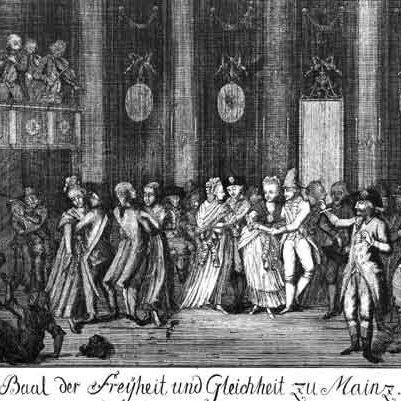
Just two days after the city's surrender, a Jacobin club was founded in Mainz based on the French model, initially consisting of 20 students, professors, civil servants, and merchants under the name "Society of Friends of Liberty and Equality," which soon established branches in Worms and Speyer. Although Custine did not want to change the political order of the Electorate until the locals had freely voted to accept the "Franconian Constitution," on November 18 and 19, he replaced the old civil service with a so-called "General Administration." Anton Joseph Dorsch and Georg Forster were appointed chairmen. The cities of Mainz, Worms, and Speyer (later also Bingen) soon received their own additional administrations.
With the support of their newly created administration and the rapidly growing Jacobin clubs, the French now engaged in massive propaganda in the area between Landau and Bingen on the left bank of the Rhine. Far more effective than posters or leaflets, the ideas of the revolution were conveyed through the erection of so-called trees of liberty. These tied in with the centuries-old tradition of church consecration customs and were soon to be found in almost every village, which also contributed to the popularity of the French.
Disappointed by the continuing inertia of the population in the "liberated" areas, the Paris National Convention decreed on December 15, 1792, the compulsory introduction of French democracy throughout the territory occupied by the revolutionary army. In addition, the French were also coming under increasing military pressure: on December 2, allied German troops had recaptured the city of Frankfurt am Main; the myth of Custine's invincibility was shattered, and the French army was forced to retreat to the mouth of the Main River.
Elections to the Rhenish-German National Convention
Nevertheless, elections to a so-called "Rhenish-German National Convention" took place on February 24, 1793, although they were associated with considerable difficulties: Before the election, voters had to take an oath of allegiance to popular sovereignty, freedom, and equality, which in many places led to heated debates or even refusals to vote for fear of reprisals as the Prussian-Hessian army drew ever closer. In addition, the area between Bingen and Landau designated for the elections had not been adequately covered by the French administration. Only 130 freely elected representatives were sent to the Rhenish-German National Convention, which was therefore only able to make decisions on behalf of these locations.
Rhenish-German Free State
After attending High Mass together in St. Peter's Church – in order to counter the frequently voiced accusation that the Revolution was hostile to religion – the Rhenish-German National Convention was constituted on March 17, 1793, in the Knights' Hall of the Deutschhaus in Mainz. Anton Joseph Hofmann was elected president of the convention, with Georg Forster as his deputy.
The very next day, the delegates – predominantly members of the Jacobin clubs – decreed that "the entire stretch of land from Landau to Bingen, which sends deputies to this convention, shall from now on constitute a free, independent, and indivisible state and obey the common laws based on liberty and equality," the so-called "Rhenish-German Free State" (H. Scheel). In the same coup, "all previous arbitrary powers were abolished."
This decree was a truly revolutionary act. Heinrich Scheel describes it as "the birth certificate of bourgeois democracy in Germany," as it was the first German document to profess the sovereignty of the people, equality before the law, and political freedom.
Formal connection to France
On March 21, 1793, the deputies unanimously decided to ask the Paris National Convention to unite the Rhenish-German Free State, which was not viable on its own, with the "mother country" of France. On March 25, a delegation consisting of Georg Forster, the merchant Georg Patocki, and the 27-year-old Mainz doctor of philosophy Adam Lux set off for Paris.
The request for unification, known as the "Reunionsadresse," was enthusiastically accepted by the deputies of the Paris National Convention on March 30, but the union took place only on paper, as the allied German armies had already recaptured the entire Mainz area and the siege ring around the city was gradually closing in.
Meanwhile, the Rhenish-German National Convention was increasingly disintegrating; many deputies had fled the city due to the worsening military situation. On March 27 and 28, the Convention imposed several security measures against emigrants and those who refused to take the oath, and on March 31, it elected a new General Administration. On March 29, however, preparations finally began to defend the city against the army of the German princes.
The siege of Mainz in 1793
As the seat of the Imperial Archchancellor, Mainz was one of the strongest fortresses in the German-speaking world and was considered virtually impregnable. After the rather embarrassing campaign that Prussia had unsuccessfully waged against Custine and his army in 1792 on behalf of the Empire, the Prussian army command saw the recapture of Mainz as a welcome opportunity to restore its reputation. In addition, the capture of the city was an important prerequisite for pushing the revolutionary army back to France.
After German troops captured Frankfurt on December 2, 1792, and the German army began its unstoppable advance on Mainz, Custine had Kastel on the right bank of the Rhine converted into an independent fortress. Nevertheless, the city of Mainz was placed in a state of defense (état de défense) on December 13, 1792, and in a state of siege (état de siège) on January 26, 1793. By the beginning of May, however, the siege ring, consisting of 44,000 soldiers with 323 guns, had finally closed.
Mainz was well equipped for defense with 33,000 men and 270 cannons. On the night of June 16-17, the besiegers began shelling the city from the hill outside Weisenau and advanced closer and closer to the fortress walls within a few days. On June 27, they finally deployed heavy artillery for the first time, which led to devastating fires and destruction within the city on the night of June 28-29.
The end of the Mainz Republic
Although surrender was by no means necessary for military reasons, the French handed over the city to the besiegers on July 22/23, 1793, in order to avoid unnecessary losses and achieve free withdrawal—especially since the French soldiers were unwilling to risk their lives to defend a foreign city that was considered foreign considered foreign despite its formal annexation to France. On July 24 and 25, the French left the city of Mainz; after only nine months, the brief era of the Mainz Republic ended as abruptly as it had begun – with a military conquest of the city.
Bibliography of the most important titles on the topic
Federal Archives and City of Mainz (eds.), German Jacobins: The Mainz Republic and the Cisrhenans, 1792–1798, vols. 1–3, Mainz, 1981.
State Parliament of Rhineland-Palatinate (eds.), The Mainz Republic. The Rhenish-German National Convention, Mainz, 1993.
Dumont, Franz, The Mainz Republic of 1792/93. Studies on the Revolution in Rheinhessen and the Palatinate, Alzey, 1982.
Scheel, Heinrich, The Republic of Mainz, vols. 1–3, Berlin, 1981–1989.
Source: This text was written by Jörg Hartmann as part of a history project in April 1997 at the Bischöfliches Willigis-Gymnasium. Only excerpts are available here.