Greening and design statutes (explanation)
Statutes on the greening and design of developed properties within the city of Mainz (greening and design statutes) dated June 25, 2022.
The ordinance took effect on October 1, 2022, and governs the landscaping and design of developed properties and structures within the city limits of Mainz. At that time, the previously applicable ordinance on green spaces within the city of Mainz was simultaneously repealed.
The goal is to shape the cityscape while taking climate change into account and preserving healthy living conditions.
Explanation of the Articles of Association
Strengthening green infrastructure is also a key issue in Mainz; it
- creates habitats for animals and plants, promotes the connectivity of biotopes, and enhances biodiversity.
- It helps trap fine particulate matter and carbon dioxide and produces oxygen.
- It supports climate protection and counteracts climate change. By providing shade over impervious surfaces, it prevents extreme surface temperatures, and evaporation from vegetation surfaces actively reduces the temperature of the surrounding air. Extreme weather conditions—such as heat waves and peak runoff following heavy rainfall—are mitigated.
- contributes to improving the working and living environment. Green spaces have a positive influence on the townscape and architectural design and shape urban structures. Sealed functional areas and parking lots are visually broken up by planting trees and structured through green elements.
On September 25, 2019, the City Council of Mainz passed a resolution declaring a “climate emergency” and tasked the administration with updating the Green Space Ordinance. Pursuant to Section 24(1), second sentence, and ( 5 of the Rhineland-Palatinate Municipal Code (GemO) as well as § 88(1)(3) and (7) of the Rhineland-Palatinate Building Code (LBauO), the City of Mainz is authorized to adopt a statute governing the greening and design of developed properties.
The ordinance applies throughout the city limits to the undeveloped areas of built-up properties, including the underground open spaces of built-up properties (such as underground parking garages, etc.), and to the exterior design of structures. The ordinance applies to projects for which a building permit application is submitted, as well as to projects exempt from permitting under the Rhineland-Palatinate Building Code (LBauO) and projects subject to the exemption procedure under § 67 LBauO.
The ordinance sets forth requirements for the design and landscaping of developed properties, front yards, parking spaces, storage areas, flat roofs, exterior walls, and commercially used storage areas. It also specifies the quality and timing of landscaping, as well as any necessary replacement planting.
According to the bylaws, all areas not covered by above-ground buildings, as well as open spaces on developed properties supported by underground levels, must be fully landscaped, unless they are required for a permitted use. Access points, driveways, paths, areas for the fire department, and vehicle parking spaces must be limited to what is functionally necessary.
Flat Roofs and Exterior Walls
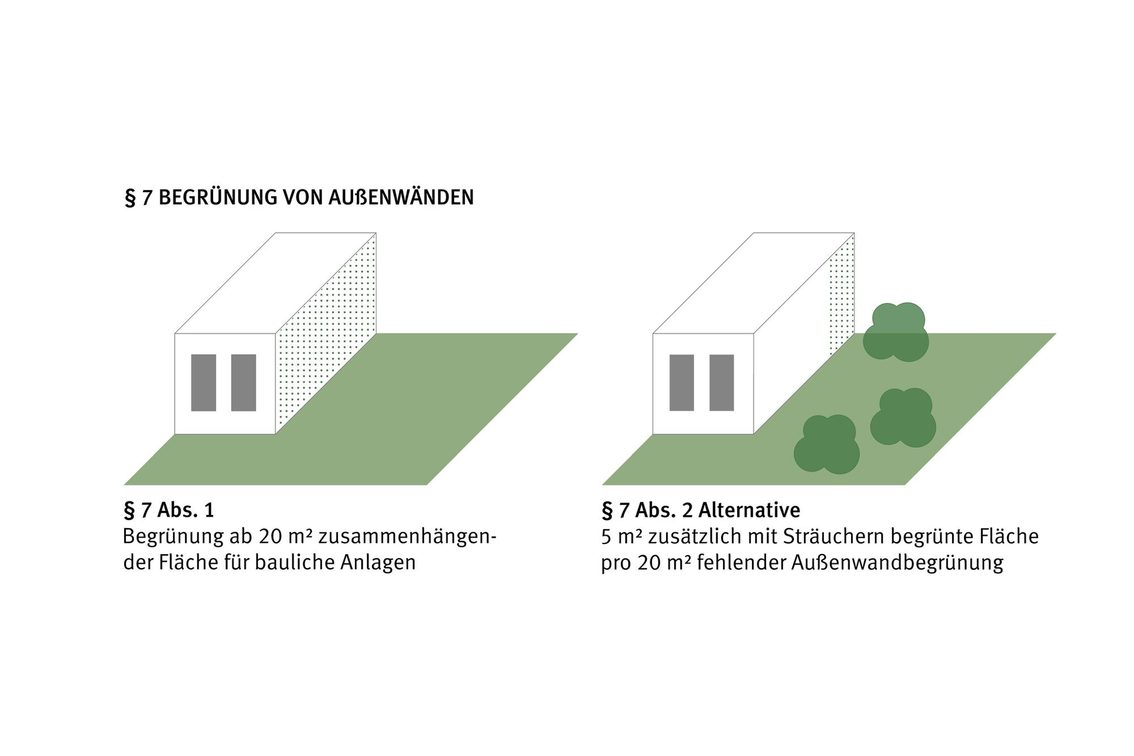
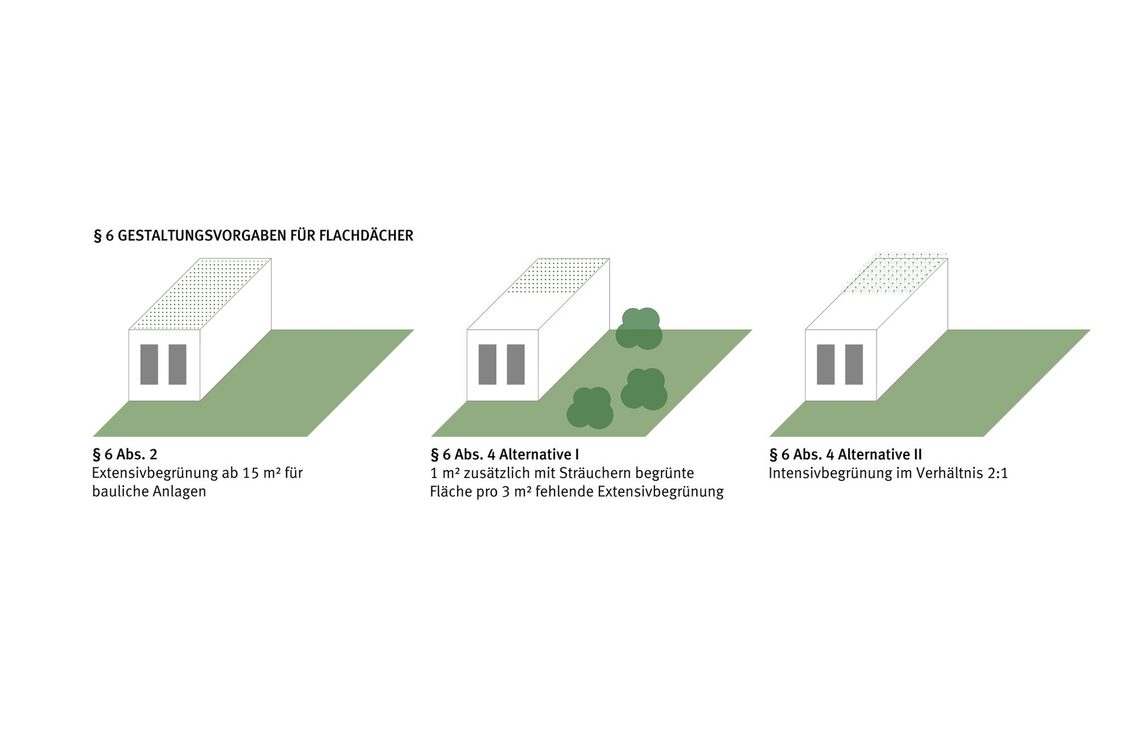
Flat roofs and exterior walls must be greened. In addition, a so-called “modular system” is used for both flat roofs and exterior walls to offer alternatives and enable customized solutions. As an alternative to greening flat roofs and exterior walls, there is the option to plant additional shrubs on the building lot. In the case of green roofs, intensive greening in a 2:1 ratio is also possible as an alternative to the required extensive greening. These alternatives ensure green space on the developed lots while allowing for greater flexibility and customized solutions. The resulting varied green structures—green roofs, green facades, and shrubs—are also urban design elements that structure, open up, and accentuate the resulting spaces. A combination with solar systems, particularly photovoltaic systems, is possible.


Trees and Shrubs

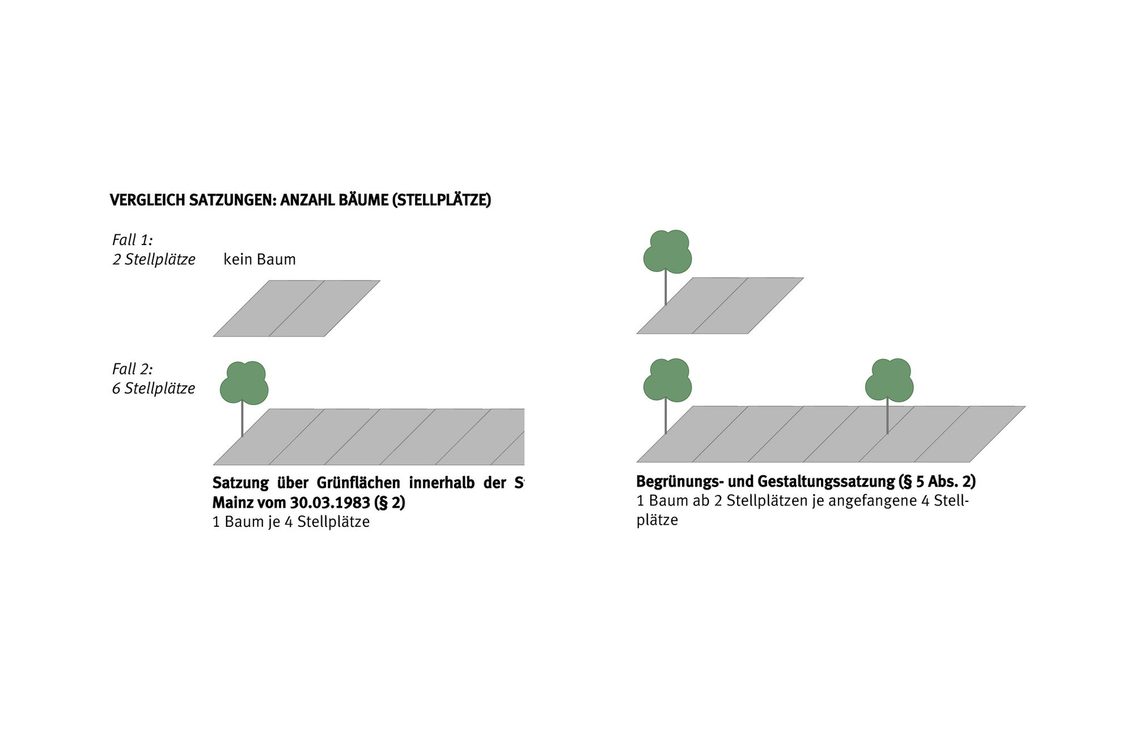
The Landscaping and Design Ordinance also governs the planting of trees and shrubs. For every four above-ground parking spaces or fraction thereof, at least one tree must be planted, provided there are at least two parking spaces.
One tree is required for every 200 m² of lot area not covered by above-ground buildings. In addition, 15% of the building lot must be planted with shrubs, provided that the planting does not conflict with an otherwise permitted use. Covered parking spaces for cars and bicycles, as well as other storage and placement areas (particularly for trash and recycling bins), must be landscaped. Commercial storage areas must be screened off from adjacent properties with different uses by shrubs. Both for shrubs and trees, existing trees and shrubs, as well as those required to be planted due to other obligations (e.g., provisions in zoning plans), are taken into account.
For climatic and design reasons, certain uses and materials are also prohibited throughout the entire urban area. For example, it is clearly stipulated that front yards may not be used as work or storage areas, and that fill material such as gravel, crushed stone, and similar materials; lawn grid blocks and gravel lawns; as well as extensive coverings with geotextiles, plastic sheeting, woven fabrics, and similar materials do not count as green spaces. The creation of so-called “gravel gardens” is therefore no longer permitted.
Contact us
Address
Environmental planning
Grün- und Umweltamt, Haus D
Geschwister-Scholl-Straße 4
55131 Mainz
Postal address
55028 Mainz